Frequently asked
Is tonight good for stargazing at Fort Union Trading Post?
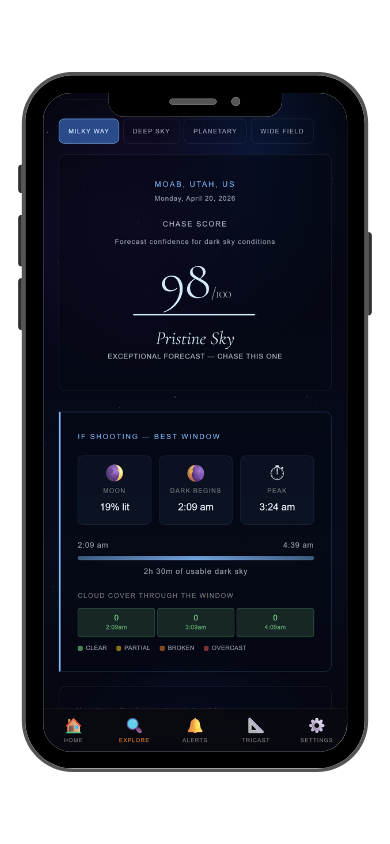
The live score above pulls today's forecast and runs it through StarCast's scoring model, factoring in cloud cover, moon illumination, Bortle class, humidity, and atmospheric transparency. Above 70 is an excellent night. Below 40, conditions are poor. The score updates daily.
What makes Fort Union Trading Post good for astrophotography?
Fort Union Trading Post National Historic Site sits at the confluence of the Yellowstone and Missouri Rivers on the North Dakota-Montana border, one of the most remote corners of the northern Great Plains. The reconstructed 19th-century fur trading post — once the most important trading point in the upper Missouri River country — rises from the river bottom beneath an enormous Great Plains sky. Bortle Class 2 skies are common here, with a completely flat and dark horizon in all directions across the surrounding river breaks and open range. The historic fort walls and bastions silhouetted against the Milky Way create a powerful foreground that spans both natural and human history on the northern plains.
When is the Milky Way visible at Fort Union Trading Post?
The galactic core is visible from April through October, peaking in July and August. The northern Great Plains location delivers reliable clear nights, particularly in late summer and fall. Weather can change quickly on the open plains, but thunderstorms typically move through rapidly. The historic site has limited after-hours access, and the surrounding river bottom and upland areas near the confluence provide viewing positions outside the park's operating hours. Winter brings long, extremely cold nights with aurora potential at this northerly latitude.