Frequently asked
Is tonight good for stargazing at Galloway Forest Park?
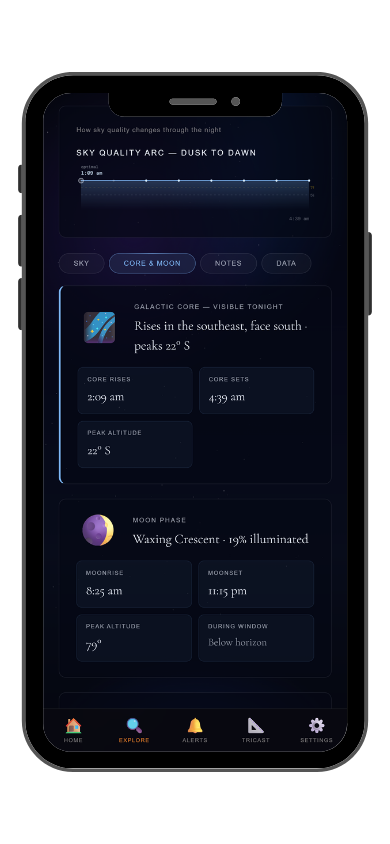
The live score above pulls today's forecast and runs it through StarCast's scoring model, factoring in cloud cover, moon illumination, Bortle class, humidity, and atmospheric transparency. Above 70 is an excellent night. Below 40, conditions are poor. The score updates daily.
What makes Galloway Forest Park good for astrophotography?
Galloway Forest Park in southwest Scotland was the UK's first Dark Sky Park, designated by the Forestry Commission and the British Astronomical Association in 2009. The park covers 800 square kilometers of conifer forest, moorland, and loch country in Dumfries and Galloway, far from any major urban center. The Galloway Hills block the glow from Glasgow and Edinburgh, and the Irish Sea to the southwest provides a dark horizon. Bortle Class 2 conditions are measured at the Clatteringshaws Loch area, one of the designated dark sky discovery sites within the park. The park's lochs, forest edges, and open moorland give a variety of foreground options.
When is the Milky Way visible at Galloway Forest Park?
The galactic core is visible from March through October. Scotland's weather is changeable, but Galloway tends to be drier than the Highlands due to its southern position and lower elevation. Spring (April through May) and autumn (September through October) are when the most stable high-pressure systems settle over southwest Scotland, delivering the clearest nights. The galactic core is relatively low in the southern sky at 55 degrees north but is visible and photographable above the treeline from open areas. Winter brings aurora potential: the park's dark skies make even moderate displays vivid.