Frequently asked
Is tonight good for stargazing at Gates of the Arctic National Park?
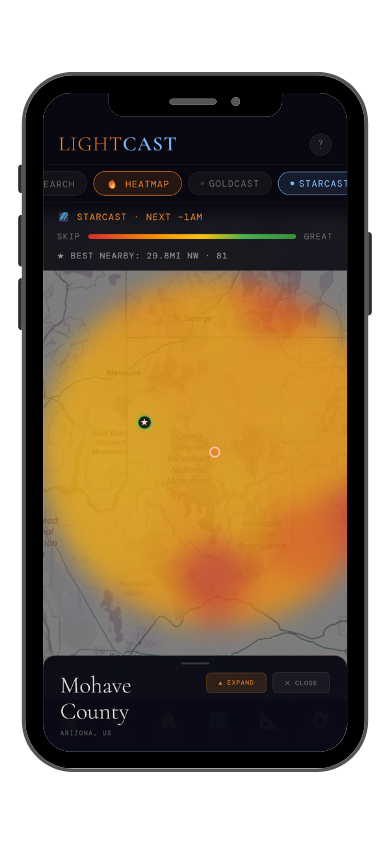
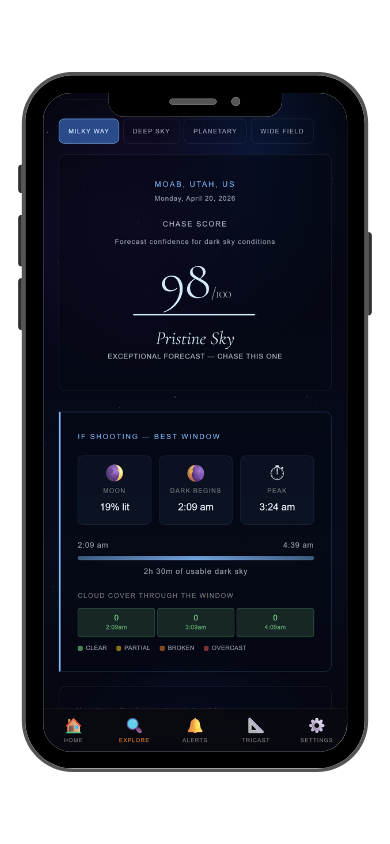
The live score above pulls today's forecast and runs it through StarCast's scoring model, factoring in cloud cover, moon illumination, Bortle class, humidity, and atmospheric transparency. Above 70 is an excellent night. Below 40, conditions are poor. The score updates daily.
What makes Gates of the Arctic National Park good for astrophotography?
Gates of the Arctic National Park lies entirely above the Arctic Circle, making it the northernmost national park in the United States. It has no roads, no trails, no visitor facilities, and no entrance stations — it is pure wilderness accessible only by bush plane. The park records Bortle Class 1 skies of extreme quality, with absolutely no artificial light influence in any direction across its 8.5 million acres of Brooks Range wilderness. The jagged peaks, braided arctic rivers, and open tundra provide expansive foreground under one of the darkest skies on the planet. At this latitude, the aurora borealis is among the most active and dramatic anywhere on Earth, regularly filling the sky from horizon to horizon with curtains of green, red, and purple light above the arctic mountain landscape.
When is the Milky Way visible at Gates of the Arctic National Park?
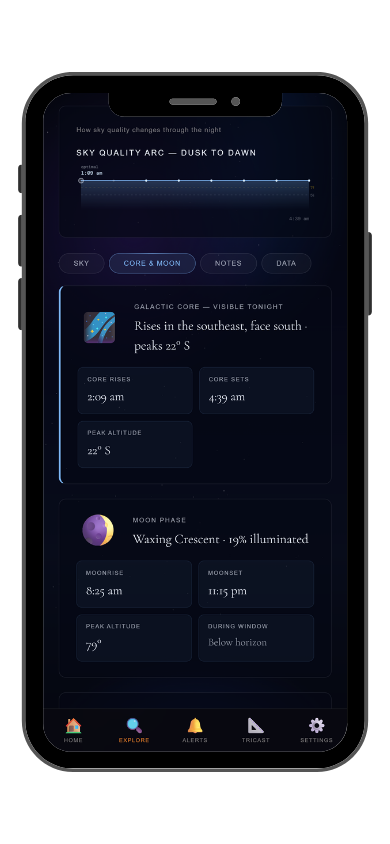
Above the Arctic Circle, the sun does not set at all from late May through mid-July, making summer night photography impossible. Darkness returns in late July and grows rapidly, with full aurora season underway by August. The galactic core is briefly visible in August and September before dropping too low for the remainder of the season. Aurora photography is the defining night sky experience here, running from late July through April. The extreme remoteness and harsh conditions demand full expedition preparation and bush plane logistics for any visit.