Frequently asked
Is tonight good for stargazing in Glenwood Springs?
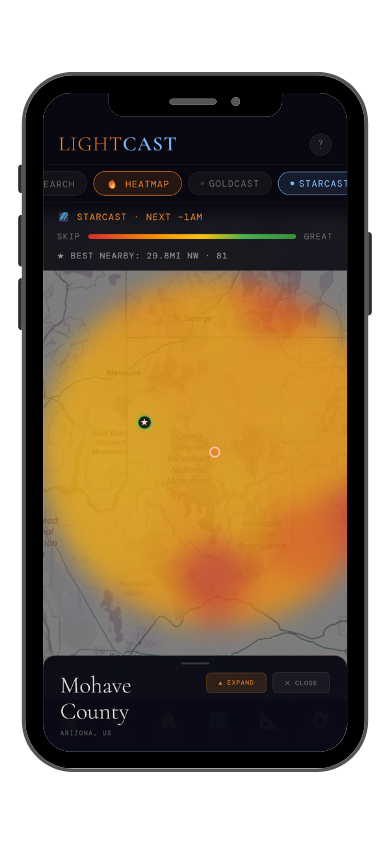
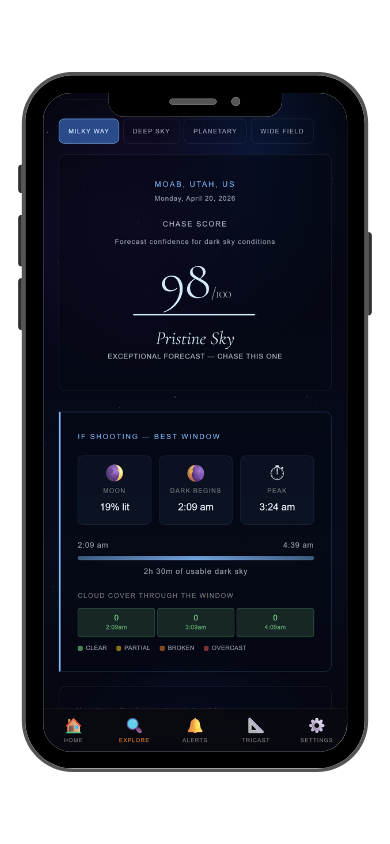
The live score above pulls today's forecast and runs it through StarCast's scoring model, factoring in cloud cover, moon illumination, Bortle class, humidity, and atmospheric transparency. Above 70 is an excellent night for astrophotography. Below 40, conditions are poor. The score updates daily.
What makes Glenwood Springs good for astrophotography?
Glenwood Springs sits at 5,700 feet at the confluence of the Colorado and Roaring Fork rivers, inside the narrowest section of Glenwood Canyon — one of the most dramatic river canyon landscapes in Colorado. The town itself has moderate light output, but Glenwood Canyon's red sandstone walls rise 1,800 feet immediately behind the town, and the White River National Forest extends in all directions with rapid access to dark terrain. Sunlight Mesa, Flat Tops Wilderness, and the surrounding canyon country to the west and north provide Bortle Class 3 conditions within 20 to 30 minutes of town. The canyon walls serve as natural light shields, and the steep terrain east of town blocks the Aspen metro light dome effectively. Flat Tops Wilderness to the north is one of Colorado's most isolated and dark wilderness areas.
When is the Milky Way visible near Glenwood Springs?
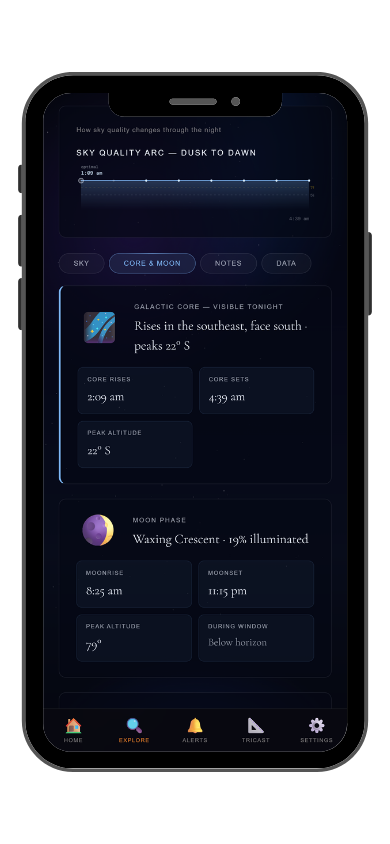
The galactic core is visible from late March through early October at this latitude. Prime astrophotography season runs May through September. The canyon terrain immediately around Glenwood Springs creates challenges for low-horizon shots, but the mesa tops above the canyon offer wide, open skies. Flat Tops Wilderness to the north — accessible via the Flat Tops Scenic Byway — is a premier destination for serious astrophotographers wanting Bortle Class 2 conditions and an alpine plateau foreground. Colorado monsoon clouds in July and August affect this area but typically clear by late evening.