Frequently asked
Is tonight good for stargazing at Goosenecks State Park?
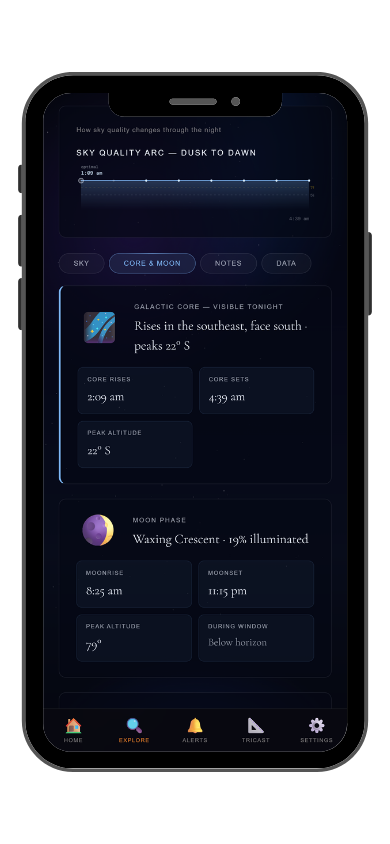
The live score above pulls today's forecast and runs it through StarCast's scoring model, factoring in cloud cover, moon illumination, Bortle class, humidity, and atmospheric transparency. Above 70 is an excellent night. Below 40, conditions are poor. The score updates daily.
What makes Goosenecks good for astrophotography?
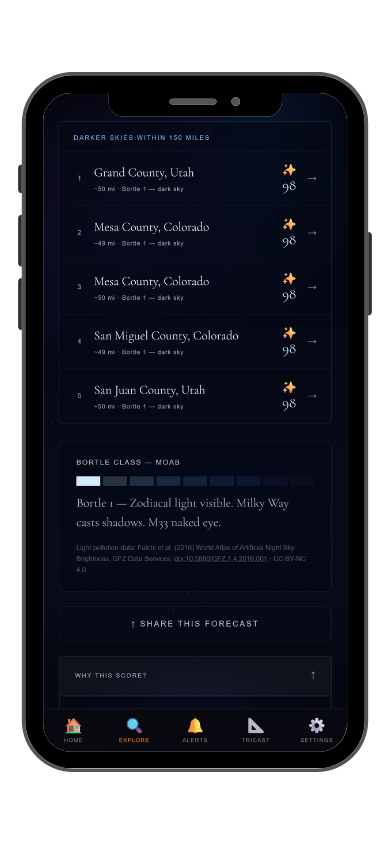
Goosenecks State Park overlooks one of the most extreme entrenched meanders in the world: the San Juan River winds through 1,000-foot deep canyons across a five-mile stretch of landscape that covers less than a mile in a straight line. The overlook sits in one of the darkest corners of Utah, well within the Bears Ears dark sky region, with Bortle Class 2 conditions. The canyon geometry creates a natural leading line through the frame, and the river below reflects starlight on calm nights. There's no light dome in any direction, and the park charges no entrance fee.
When is the Milky Way visible at Goosenecks?
The galactic core is visible from March through October. The core rises to the southeast, which aligns directly over the deepest part of the canyon meander when viewed from the main overlook. Mid-May through August offers the best combination of core altitude and overnight dark hours. The desert stays warm into September and October, making those months comfortable for shooting after the summer monsoon season winds down.