Frequently asked
Is tonight good for stargazing at Grand Staircase-Escalante National Monument?
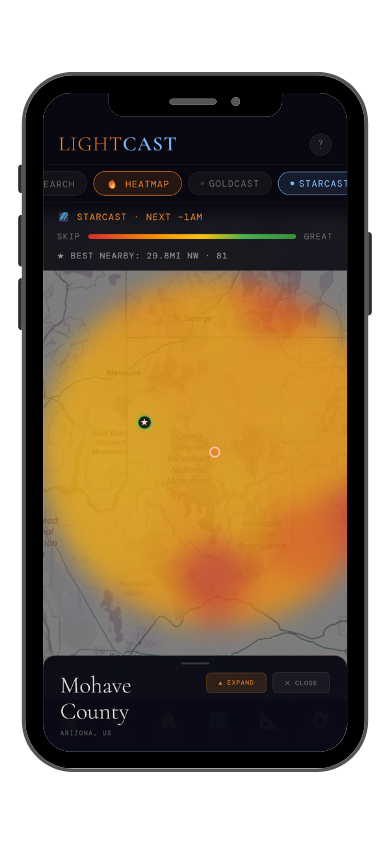
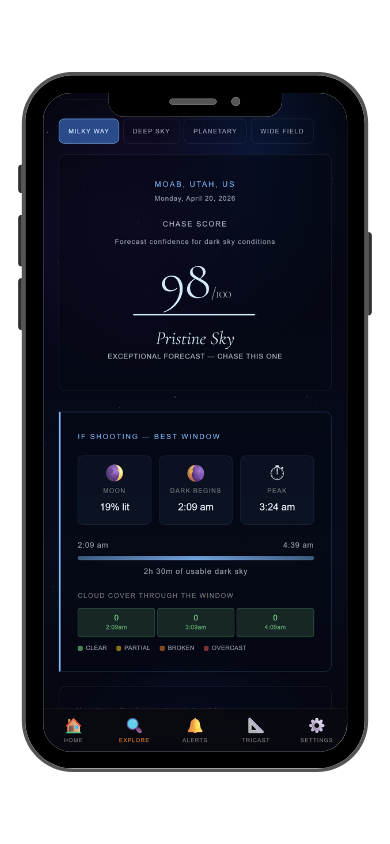
The live score above pulls today's forecast and runs it through StarCast's scoring model, factoring in cloud cover, moon illumination, Bortle class, humidity, and atmospheric transparency. Above 70 is an excellent night. Below 40, conditions are poor. The score updates daily.
What makes Grand Staircase-Escalante National Monument good for astrophotography?
Grand Staircase-Escalante National Monument covers nearly 1.9 million acres of some of the most remote and rugged terrain in the continental United States. Located in south-central Utah between Capitol Reef and Bryce Canyon, it contains Bortle Class 1 to 2 skies across much of its vast interior — among the darkest accessible anywhere in the lower 48 states. The monument encompasses an extraordinary diversity of landscape: slot canyons, petrified sand dunes, ancient Anasazi ruins, wave-like sandstone formations, and dramatic mesa edges. Locations like Coyote Buttes, The Wave, and the Escalante River canyons are world-renowned for their geological beauty and serve as extraordinary foreground for night photography. The nearest towns of Escalante, Boulder, and Kanab are small enough to have minimal impact on the dark horizon.
When is the Milky Way visible at Grand Staircase-Escalante?
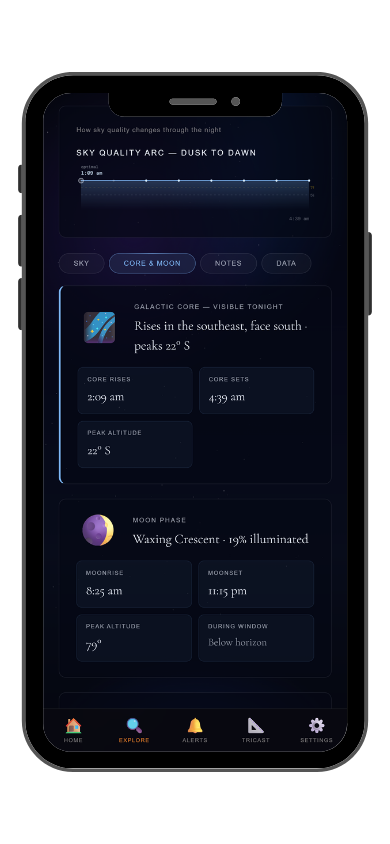
The galactic core is visible from approximately March through October, with May through August the brightest window. Utah's high desert location provides very high clear night frequency, though summer monsoons can affect the region from July through early September. Many of the most photogenic locations within the monument require long drives on unpaved roads, and some require permits obtained well in advance. Spring and fall offer the most comfortable temperatures for desert shooting and excellent transparency.