Frequently asked
Is tonight good for stargazing at Grasslands National Park?
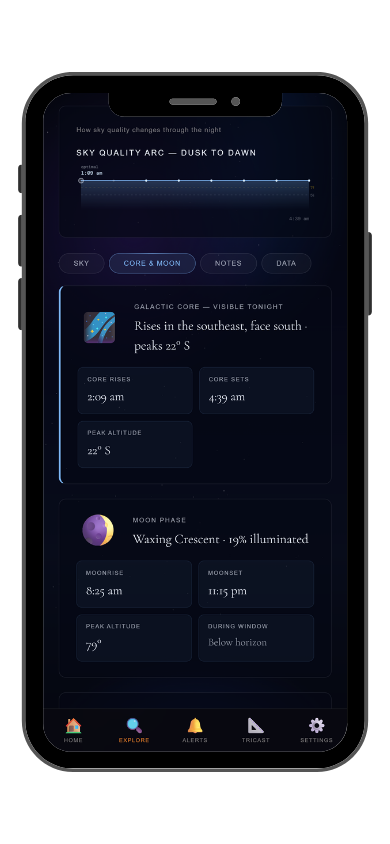
The live score above pulls today's forecast and runs it through StarCast's scoring model, factoring in cloud cover, moon illumination, Bortle class, humidity, and atmospheric transparency. Above 70 is an excellent night. Below 40, conditions are poor. The score updates daily.
What makes Grasslands good for astrophotography?
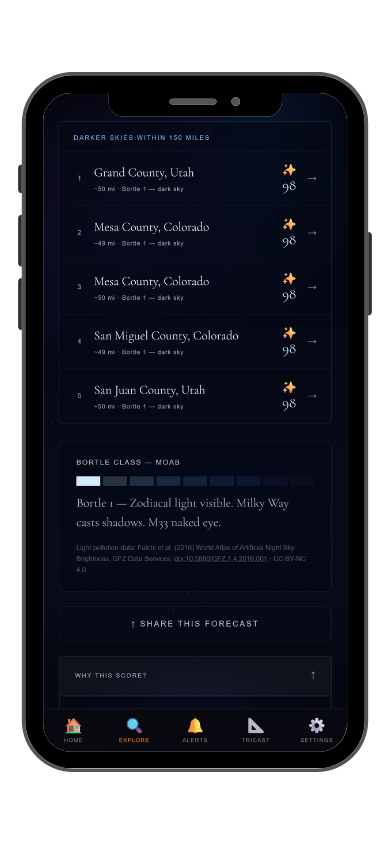
Grasslands National Park in southern Saskatchewan was Canada's first national park designated specifically as a Dark Sky Preserve. It protects the last large expanse of mixed-grass prairie in the country, an open, flat landscape with a 360-degree horizon and virtually no artificial light. The nearest towns are small: Val Marie to the north and the US border to the south, with Montana's open plains continuing the darkness. Bortle Class 1 skies are typical across the park. The flat terrain means star-to-horizon compositions in every direction, and the prairie landscape with coulees and buttes gives subtle but distinctive foreground.
When is the Milky Way visible at Grasslands?
The galactic core is visible from April through September. Saskatchewan's dry continental climate keeps the air stable and clear through much of the summer. The prairie at night can be surprisingly cold even in July, with temperatures dropping quickly after sunset on clear nights. The flat terrain means the core is visible from the moment it clears the southeast horizon. Winter visits offer a different experience: the northern lights are frequently visible from the park on geomagnetically active nights, with the open treeless horizon maximizing the display.