Frequently asked
Is tonight good for stargazing at Great Divide Basin?
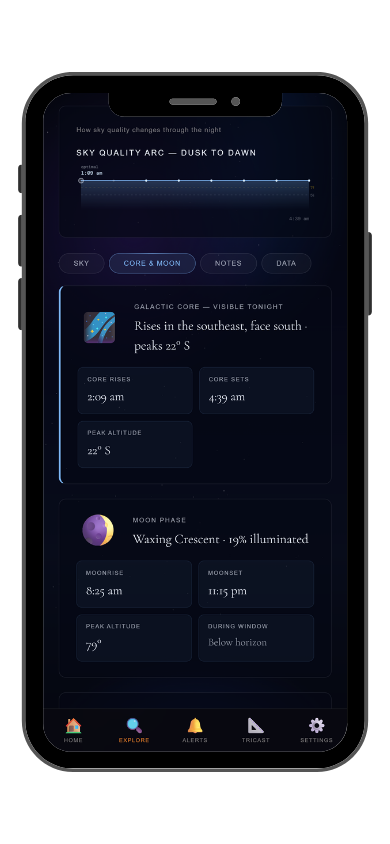
The live score above pulls today's forecast and runs it through StarCast's scoring model, factoring in cloud cover, moon illumination, Bortle class, humidity, and atmospheric transparency. Above 70 is an excellent night. Below 40, conditions are poor. The score updates daily.
What makes Great Divide Basin good for astrophotography?
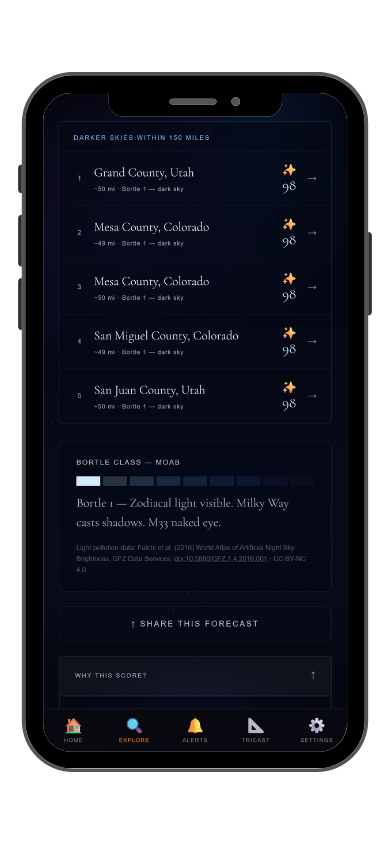
The Great Divide Basin is a closed hydrological basin in south-central Wyoming where water neither flows to the Pacific nor the Atlantic: it simply evaporates. The landscape is high desert sagebrush flats at around 6,700 feet, largely roadless, and almost entirely uninhabited. It is one of the largest and darkest stretches of land in the lower 48 states. Light pollution is effectively absent in every direction on a clear night, with Bortle Class 1 to 2 conditions widespread. Wild horses roam the basin and can appear in foreground compositions.
When is the Milky Way visible at Great Divide Basin?
The galactic core is visible from April through October. Wyoming's high desert climate keeps the air dry and stable for much of the year, with the clearest nights falling between May and September. The basin is remote: bring enough fuel and supplies for a self-sufficient overnight trip. The basin's flat horizon in all directions means the core is visible from the moment it clears the southeast until it sets in the southwest, giving a full arc transit window on good nights.