Frequently asked
Is tonight good for stargazing at Great Sand Dunes?
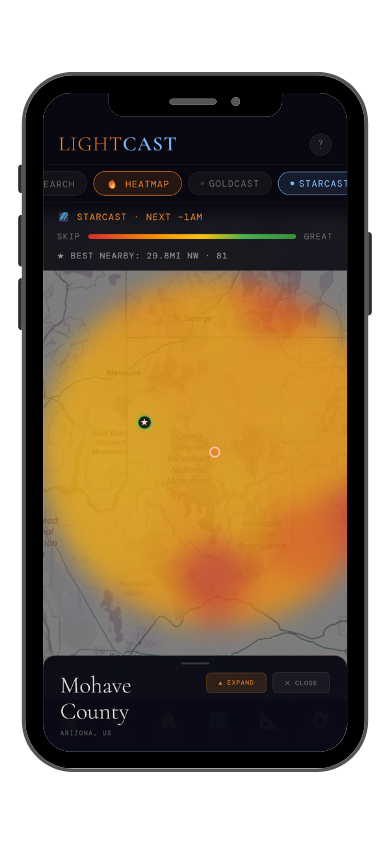
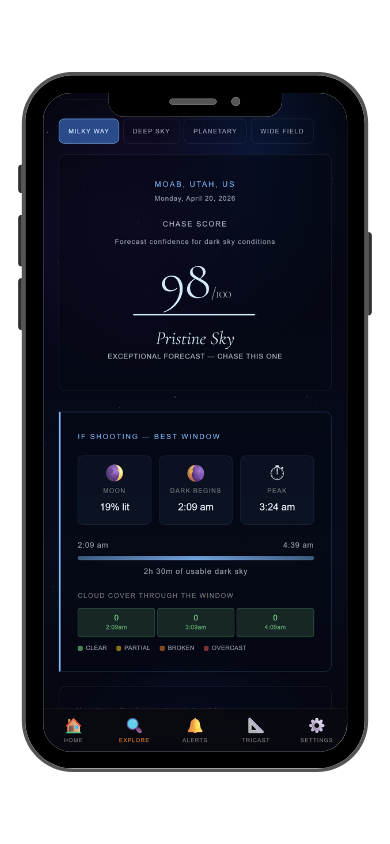
The live score above pulls today's forecast and runs it through StarCast's scoring model, which factors in cloud cover, moon illumination, Bortle class, humidity, and atmospheric transparency. Above 70 is an excellent night. Below 40, conditions are poor. The score updates daily.
What makes Great Sand Dunes good for astrophotography?
Great Sand Dunes is a Gold Tier International Dark Sky Park in Colorado's San Luis Valley, one of the largest flat, high-altitude valleys in North America. The dunes, which reach up to 750 feet, create sweeping sculpted foreground that catches starlight in a way that's unlike anywhere else in the Rockies. The Sangre de Cristo Mountains rise sharply to the east, and the valley floor stretches dark and flat to the west. Medano Creek, which flows seasonally at the dune base, adds reflective water foreground in late spring. Bortle class is 2 to 3 in the valley, with almost no nearby towns generating significant glow.
When is the Milky Way visible at Great Sand Dunes?
The galactic core is visible from March through October. Late May and early June combine Milky Way season with Medano Creek flow, which is a short window worth targeting specifically. Summer afternoons frequently bring thunderstorms that clear by midnight, leaving exceptionally transparent skies. The dunes are open 24 hours and the campground puts you on-site for the full night without a drive.