Frequently asked
Is tonight good for stargazing at Guadalupe Mountains?
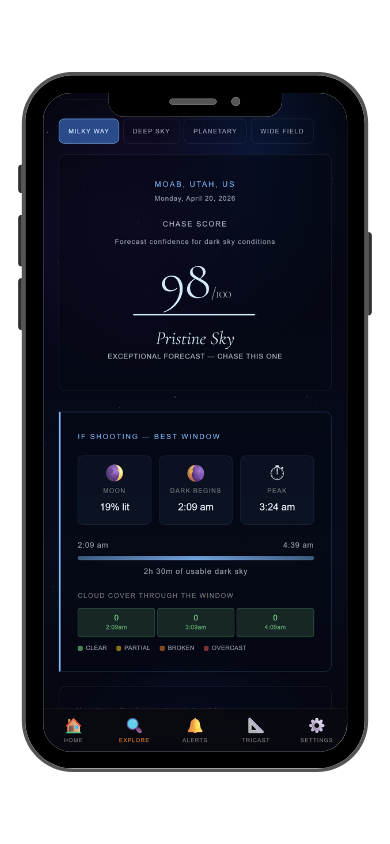
The live score above pulls today's forecast and runs it through StarCast's scoring model, which factors in cloud cover, moon illumination, Bortle class, humidity, and atmospheric transparency. Above 70 is an excellent night. Below 40, conditions are poor. The score updates daily.
What makes Guadalupe Mountains good for astrophotography?
Guadalupe Mountains is one of the least visited national parks in the country and sits adjacent to the Chihuahuan Desert, putting it in some of the darkest skies in Texas. The park is a Gold Tier International Dark Sky Park. El Capitan, the sheer limestone cliff that defines the park's southern face, is the signature foreground: it rises 1,000 feet from the desert floor and photographs dramatically against the Milky Way. The surrounding desert is flat and accessible, and the nearest significant towns are far enough away that all horizons stay dark. Neighboring Big Bend is more famous, but Guadalupe is closer to El Paso and less crowded on peak weekends.
When is the Milky Way visible at Guadalupe Mountains?
The galactic core is visible from March through October. Spring and fall are the most comfortable for overnight shooting: summer nights at elevation stay warm but manageable, and the Chihuahuan Desert sees afternoon thunderstorms in July and August that occasionally linger into the night. The park's remote location means you should plan fuel and supplies carefully; the nearest services are limited.