Frequently asked
Is tonight good for stargazing in Gunnison?
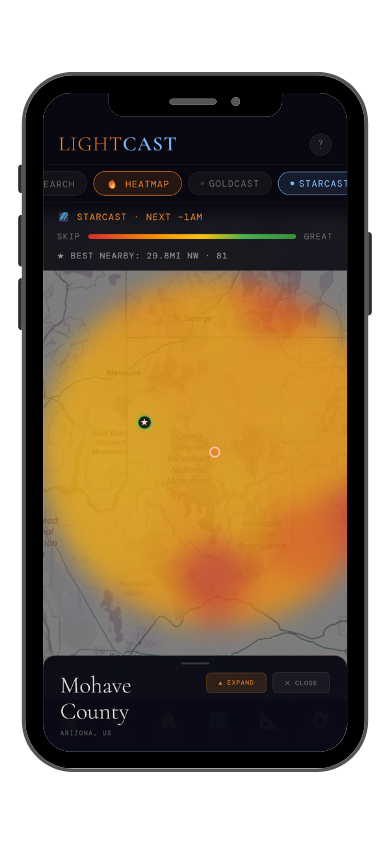
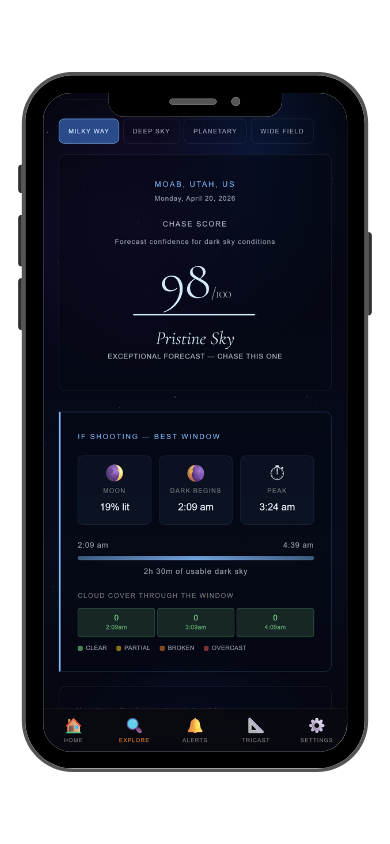
The live score above pulls today's forecast and runs it through StarCast's scoring model, factoring in cloud cover, moon illumination, Bortle class, humidity, and atmospheric transparency. Above 70 is an excellent night for astrophotography. Below 40, conditions are poor. The score updates daily.
What makes Gunnison good for astrophotography?
Gunnison sits at 7,700 feet in the broad Gunnison Valley, one of the coldest and most isolated high-altitude valleys in Colorado. The surrounding terrain — Curecanti National Recreation Area, Blue Mesa Reservoir, Black Canyon of the Gunnison, and the Gunnison National Forest — creates an enormous protected area with genuinely dark skies in every direction. Blue Mesa Reservoir, the largest body of water in Colorado, sits just west of town and is a compelling night photography foreground with its fingers extending into the sage-covered canyon landscape. Bortle Class 2 to 3 darkness is readily available from a short drive in almost any direction. The valley's high elevation, low humidity, and distance from any large metro area produce excellent atmospheric transparency year-round.
When is the Milky Way visible in Gunnison?
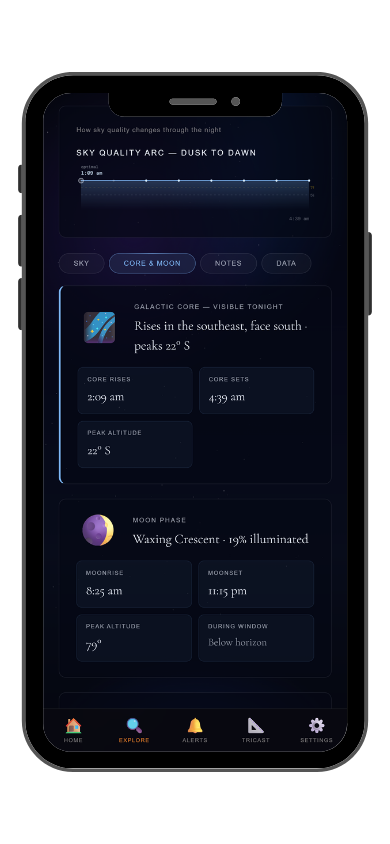
The galactic core is visible from late March through early October at Gunnison's elevation and latitude. Prime astrophotography season runs May through September. Blue Mesa Reservoir and the surrounding canyon terrain are excellent May through early July before summer thunderstorm frequency peaks. The Gunnison Valley sees significant afternoon storm activity in July and August, but clear evenings are common as storms typically push east over the Continental Divide. This is one of the best-positioned communities in Colorado for low-effort access to very dark skies given its proximity to multiple protected areas.