Frequently asked
Is tonight good for stargazing in Hanksville?
The live score above pulls today's forecast and runs it through StarCast's scoring model, factoring in cloud cover, moon illumination, Bortle class, humidity, and atmospheric transparency. Above 70 is an excellent night for astrophotography. Below 40, conditions are poor. The score updates daily.
What makes Hanksville good for astrophotography?
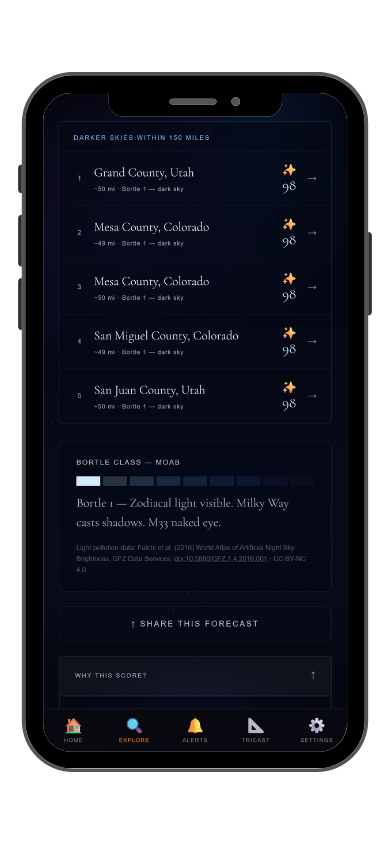
Hanksville is one of the most remote communities in the lower 48 United States, sitting at 4,300 feet at the confluence of the Dirty Devil and Fremont rivers in south-central Utah. The surrounding terrain — Capitol Reef National Park to the west, Canyonlands National Park to the east, and Glen Canyon National Recreation Area to the south — forms one of the largest contiguous dark sky regions in the continental United States. Bortle Class 1 to 2 conditions are achievable within a short drive in almost any direction. Goblin Valley State Park, 12 miles northwest, is a uniquely photogenic Mars-like landscape of sandstone hoodoos that has become a premier Milky Way photography destination. The total absence of light pollution in the Henry Mountains to the south and the San Rafael Swell to the north gives photographers a fully dark horizon in 360 degrees.
When is the Milky Way visible near Hanksville?
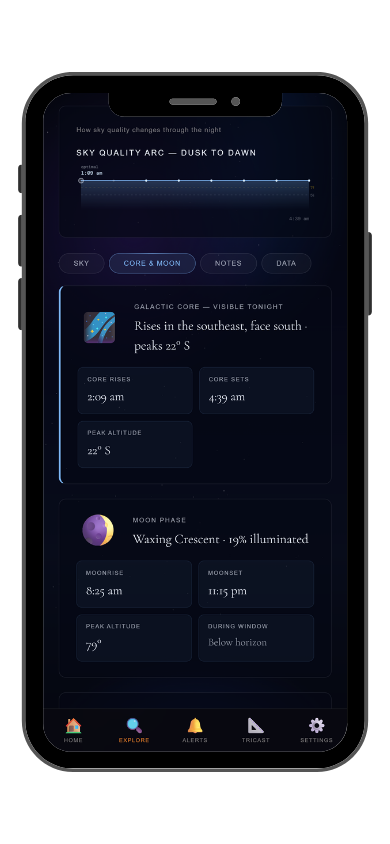
The galactic core is visible from late February through late October at Hanksville's central Utah latitude — one of the most generously long seasons in the country. Goblin Valley and the surrounding canyon country are accessible year-round, though summer temperatures at this elevation require planning for heat and hydration. Prime astrophotography season runs April through October, with June and July offering the highest core altitude. The desert climate means very low annual precipitation and exceptional atmospheric transparency. This is arguably the best-positioned community in the American West for immediate access to genuinely world-class dark skies without significant driving.