Frequently asked
Is tonight good for stargazing at Iriomote-Ishigaki?
The live score above pulls today's forecast and runs it through StarCast's scoring model, factoring in cloud cover, moon illumination, Bortle class, humidity, and atmospheric transparency. Above 70 is an excellent night. Below 40, conditions are poor. The score updates daily.
What makes Iriomote-Ishigaki good for astrophotography?
Iriomote-Ishigaki National Park covers the Yaeyama Islands at the southwestern tip of Japan, just north of the Tropic of Cancer at 24 degrees north. Ishigaki Island holds one of the few Dark Sky Island designations in the world, recognized by the International Dark-Sky Association. The surrounding East China Sea and Philippine Sea in every direction mean zero terrestrial light pollution on most horizons. The subtropical landscape of mangrove forests, coral reefs, and jungle-clad hills gives tropical night sky compositions unavailable elsewhere in Japan. The galactic center rises high overhead in summer, and the Crux (Southern Cross) is visible on the southern horizon from the Yaeyama Islands.
When is the Milky Way visible at Iriomote-Ishigaki?
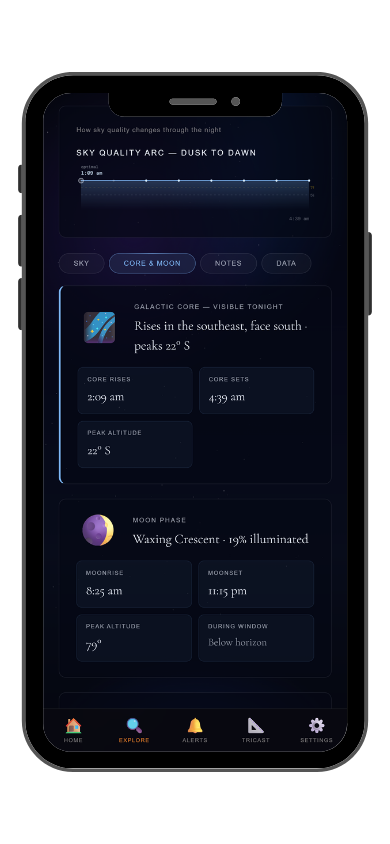
The galactic core is visible from February through October. March through June is the most productive window before rainy season cloud: the core rises early and climbs well above the southern horizon. Rainy season (May through June) brings heavy cloud, and typhoon season (July through October) introduces unpredictable weather. The clearest nights tend to fall in March, April, and from late September through November when the subtropical weather stabilizes. The northernmost visibility of the Southern Cross from Japanese territory is a notable target from the park's southernmost islands.