Frequently asked
Is tonight good for stargazing on the Isle of Mull?
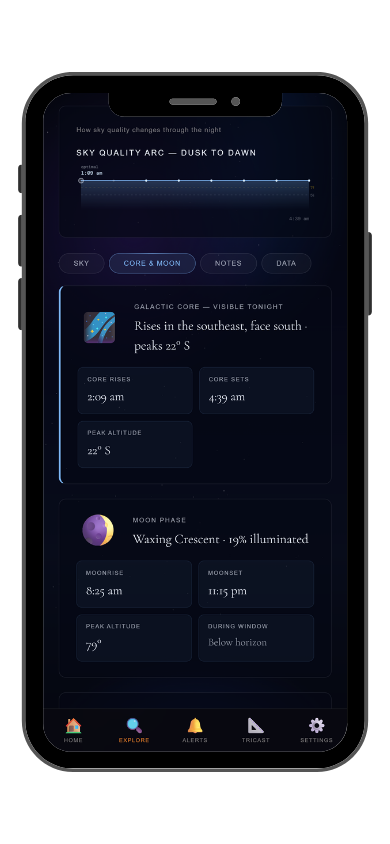
The live score above pulls today's forecast and runs it through StarCast's scoring model, factoring in cloud cover, moon illumination, Bortle class, humidity, and atmospheric transparency. Above 70 is an excellent night. Below 40, conditions are poor. The score updates daily.
What makes the Isle of Mull good for astrophotography?
The Isle of Mull off the west coast of Scotland is one of the darkest inhabited islands in the British Isles, with Bortle Class 2 to 3 skies across its interior and western coast. Mull is part of the Mull and Iona Dark Sky Community, reflecting a genuine local commitment to protecting night sky quality. The island's dramatic landscape of sea lochs, basalt cliffs, white sand beaches, and the ruins of ancient castles — including Duart Castle on the Sound of Mull — provides a distinctly Scottish foreground for astrophotography. The western shores look out across open Atlantic darkness with no light interference from the horizon. The island also sits at a latitude that makes aurora photography a realistic ambition from autumn through spring, with the northern lights visible above the black outline of Mull's hills on active nights.
When is the Milky Way visible on the Isle of Mull?
The galactic core is visible from approximately April through September, though the very short nights of June and July at this Scottish latitude compress the window of true astronomical darkness significantly. September and October offer the best balance of meaningful darkness, galactic visibility, and the onset of aurora season. Scotland's Atlantic climate brings frequent cloud cover year-round, and the west coast of Mull is particularly exposed to incoming weather — clear nights are genuine events worth capitalizing on. Winter offers long, dark nights with strong aurora potential but no galactic core.