Frequently asked
Is tonight good for stargazing at Isle of Skye?
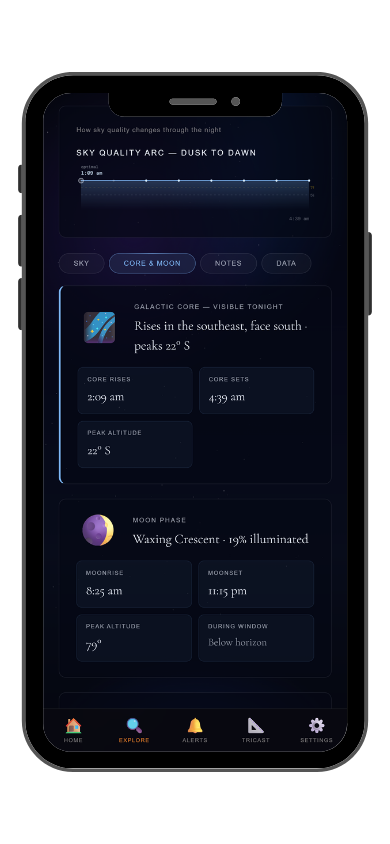
The live score above pulls today's forecast and runs it through StarCast's scoring model, factoring in cloud cover, moon illumination, Bortle class, humidity, and atmospheric transparency. Above 70 is an excellent night. Below 40, conditions are poor. The score updates daily.
What makes Isle of Skye good for astrophotography?
The Isle of Skye off the northwest coast of Scotland combines some of the most dramatic landscape in the British Isles with genuine dark skies. The Cuillin Mountains, the Quiraing, and the Old Man of Storr are among the most recognizable geological features in Europe, and on clear nights they make extraordinary foreground against the Milky Way. The island has minimal artificial light outside of Portree, and the Atlantic Ocean in every direction produces open, dark horizons. The island sits at 57 degrees north latitude, which limits the galactic core's altitude but places it well within the auroral oval for northern lights photography.
When is the Milky Way visible at Isle of Skye?
The galactic core is visible from March through October, but the best practical window is September and October: dark nights have returned after the summer solstice, the core is still positioned above the southern horizon, and the island's autumn weather, while unpredictable, produces frequent clear spells between fronts. Winter is aurora season: long dark nights and strong solar wind events make Skye one of the most accessible aurora destinations in the UK. Summer solstice nights are too bright for deep sky work at this latitude.