Frequently asked
Is tonight good for stargazing at Kakadu?
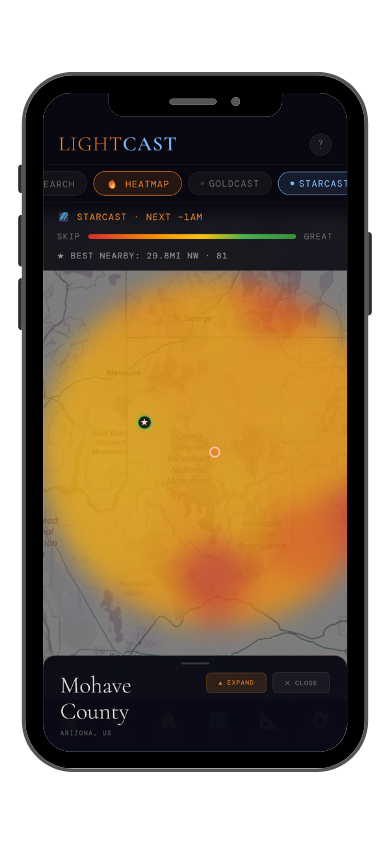
The live score above pulls today's forecast and runs it through StarCast's scoring model, factoring in cloud cover, moon illumination, Bortle class, humidity, and atmospheric transparency. Above 70 is an excellent night. Below 40, conditions are poor. The score updates daily.
What makes Kakadu good for astrophotography?
Kakadu National Park in the Northern Territory is Australia's largest national park, covering nearly 20,000 square kilometers of floodplain, escarpment, and savanna. Darwin is 250 kilometers to the northwest and produces a light dome in that direction, but the park's interior and the Arnhem Land escarpment to the east are genuinely dark. At 13 degrees south latitude, the galactic center passes nearly overhead and the Magellanic Clouds are high in the sky. The sandstone escarpment, billabongs, and ancient rock art sites create foreground options unlike anything available in temperate Australia. The Yellow Water Billabong and Ubirr escarpment area are the most accessible shooting locations.
When is the Milky Way visible at Kakadu?
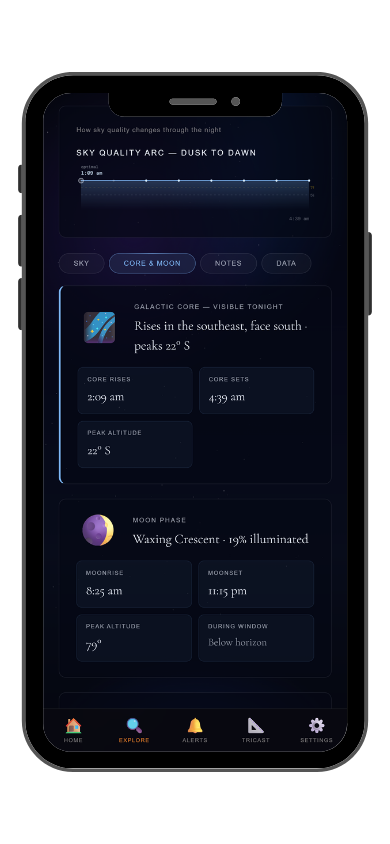
The galactic core is visible year-round at this latitude, but the dry season (May through October) is the only practical window for astrophotography. The wet season (November through April) brings monsoonal cloud and daily thunderstorms that completely block the sky. The dry season nights are clear and stable: humidity drops sharply, skies are transparent, and temperatures are comfortable overnight at 15 to 20°C. June and July are peak dry season, with the galactic center high overhead and reliable clear skies night after night.