Frequently asked
Is tonight good for stargazing in Kanab?
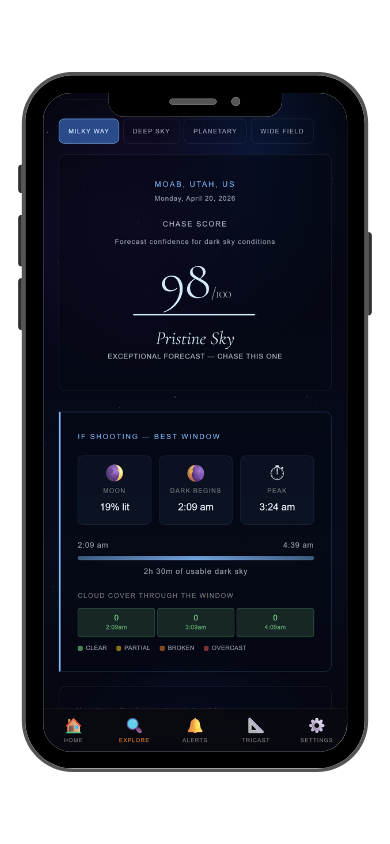
The live score above pulls today's forecast and runs it through StarCast's scoring model, factoring in cloud cover, moon illumination, Bortle class, humidity, and atmospheric transparency. Above 70 is an excellent night for astrophotography. Below 40, conditions are poor. The score updates daily.
What makes Kanab good for astrophotography?
Kanab sits at the crossroads of southern Utah's dark sky country, within an hour or two of Zion National Park, Bryce Canyon, and Grand Staircase-Escalante National Monument, which makes it a popular base camp for photographers working multiple parks in one trip. Coral Pink Sand Dunes State Park, just west of town, is a certified Dark Sky Park with pale dunes that photograph well against the night sky. The town itself sits in a valley surrounded by red rock cliffs, and outside the small amount of skyglow from Kanab's own lighting, most of the surrounding public land runs Bortle Class 2 to 3.
When is the Milky Way visible near Kanab?
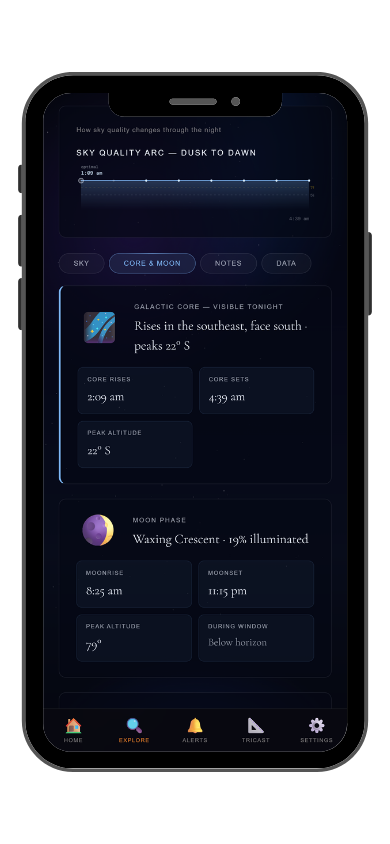
The core is visible from March through October at this latitude. The most reliable shooting windows are April through June and again in September and October, avoiding the afternoon monsoon buildup that brings cloud and lightning to southern Utah in July and August. Clear, dry air and low humidity most of the year make this one of the more consistent stretches for astrophotography in the Southwest.