Frequently asked
Is tonight good for stargazing at Karijini?
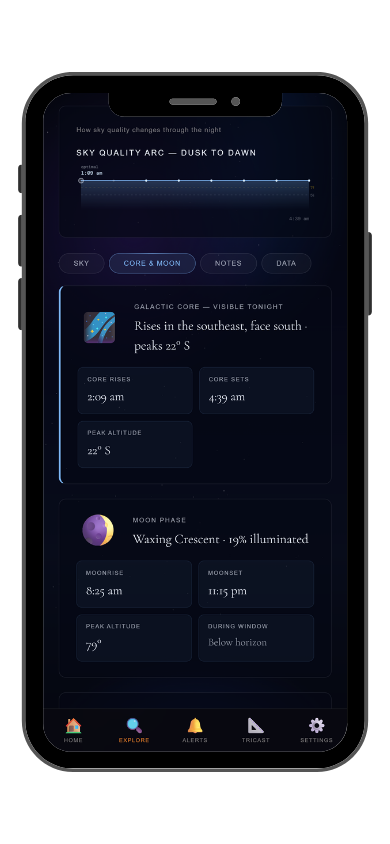
The live score above pulls today's forecast and runs it through StarCast's scoring model, factoring in cloud cover, moon illumination, Bortle class, humidity, and atmospheric transparency. Above 70 is an excellent night. Below 40, conditions are poor. The score updates daily.
What makes Karijini good for astrophotography?
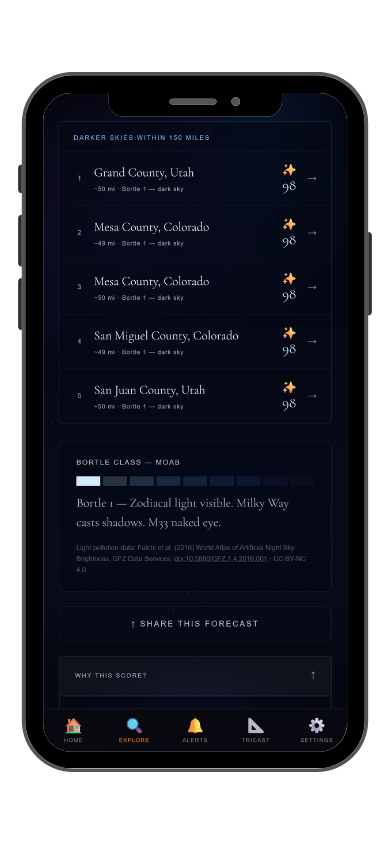
Karijini National Park in the Pilbara region of Western Australia is one of the most remote and darkest places in the country. The park sits on the ancient Hamersley Plateau, over 1,500 kilometers north of Perth, with no significant towns nearby. Bortle Class 1 skies are standard across the entire area. The gorges, carved up to 100 meters into banded iron formation rock, create a unique shooting environment: from the rim at night, the canyon below drops into absolute darkness while the sky above stretches to the horizon without obstruction. The Milky Way core rises well overhead at this latitude, and the Magellanic Clouds are prominent in the southern sky.
When is the Milky Way visible at Karijini?
The galactic core is visible from February through October. Karijini's Pilbara climate means the best shooting season falls between April and September: temperatures are cooler and cloud cover is minimal. Summer (November through March) brings cyclone-season cloud and heat that routinely exceeds 45°C. Winter nights are dry and clear with temperatures around 10 to 15°C overnight. The campground at Karijini Eco Retreat and the Dales Gorge area are the most accessible night shooting positions within the park.