Frequently asked
Is tonight good for stargazing at Kerry Dark Sky Reserve?
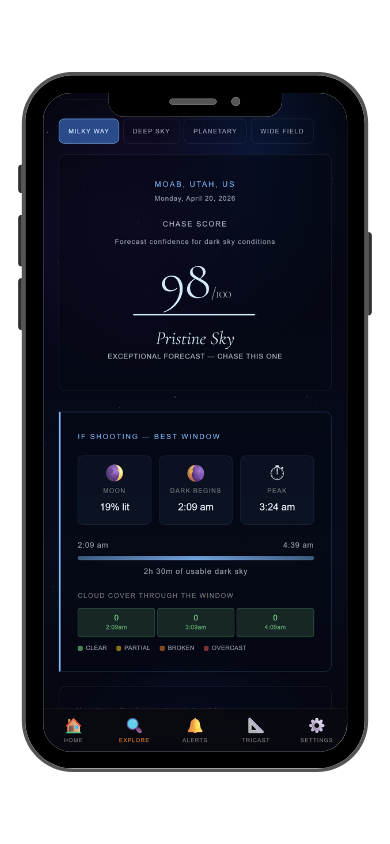
The live score above pulls today's forecast and runs it through StarCast's scoring model, factoring in cloud cover, moon illumination, Bortle class, humidity, and atmospheric transparency. Above 70 is an excellent night. Below 40, conditions are poor. The score updates daily.
What makes Kerry Dark Sky Reserve good for astrophotography?
The Kerry International Dark Sky Reserve in southwest Ireland is the only Gold Tier dark sky reserve in the Northern Hemisphere, covering the Iveragh Peninsula and including the Ring of Kerry and Killarney National Park. The Atlantic Ocean in three directions means zero light pollution on the west, north, and south horizons, and the sparse population of the peninsula keeps ground-based interference low. Bortle Class 1 conditions have been measured on the peninsula's western coast. The rugged coastline, stone bridges, and ancient ring forts give photographers a distinctly Irish foreground under some of the darkest skies in Europe.
When is the Milky Way visible at Kerry Dark Sky Reserve?
The galactic core is visible from March through October. Ireland's Atlantic climate is the main challenge: cloud and rain are frequent, and patience is part of any astrophotography trip to Kerry. Clear nights most reliably follow the passage of cold fronts when northerly or northwesterly airflow brings clean, polar air over the peninsula. March through May and September through October tend to produce the most usable clear nights relative to cloud frequency. The galactic core is low in the southern sky at this latitude, but the darkness of the site more than compensates for the limited altitude.