Frequently asked
Is tonight good for stargazing at Kitt Peak?
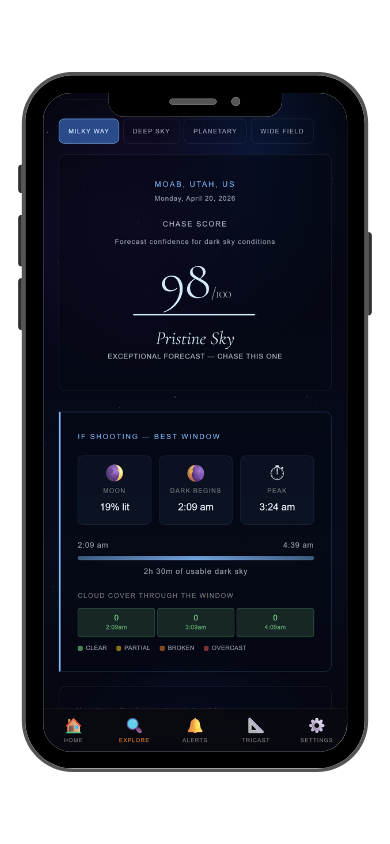
The live score above pulls today's forecast and runs it through StarCast's scoring model, factoring in cloud cover, moon illumination, Bortle class, humidity, and atmospheric transparency. Above 70 is an excellent night. Below 40, conditions are poor. The score updates daily.
What makes Kitt Peak good for astrophotography?
Kitt Peak National Observatory sits at 7,000 feet in the Quinlan Mountains of the Tohono O'odham Nation, 56 miles southwest of Tucson. It hosts 23 optical and two radio telescopes, the largest concentration of astronomical instruments in the Northern Hemisphere, chosen specifically for the site's exceptional seeing conditions. Tucson's internationally recognized dark sky lighting ordinances protect the surrounding skies, and the Tohono O'odham Nation enforces additional protections on tribal lands. Public nighttime observing programs run most nights, including an overnight program where visitors use the Visitor Center's telescopes for deep-sky imaging. The white observatory domes on the ridgeline create a distinctive astrophotography foreground unique in North America.
When is the Milky Way visible at Kitt Peak?
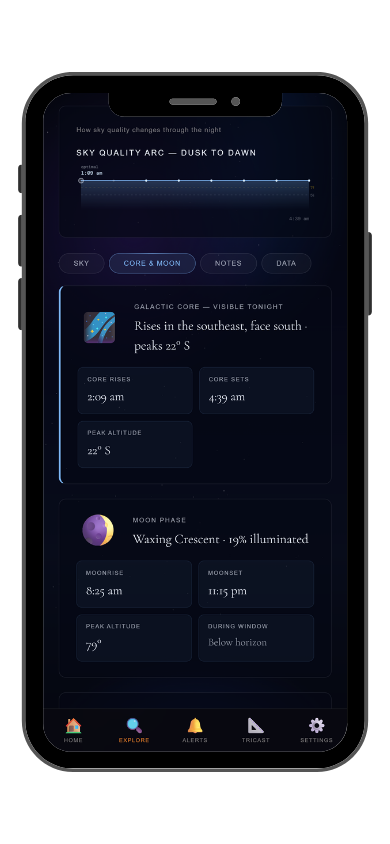
The galactic core is visible from March through October. Arizona's 300-plus clear nights per year make Kitt Peak one of the most reliable dark sky destinations in the country. The summer monsoon from July through early September is the primary exception. Nighttime programs operate year-round, weather permitting, with a call at 10 AM on the day of each program to confirm conditions. Advance reservations are required for overnight programs.