Frequently asked
Is tonight good for stargazing at Kobuk Valley National Park?
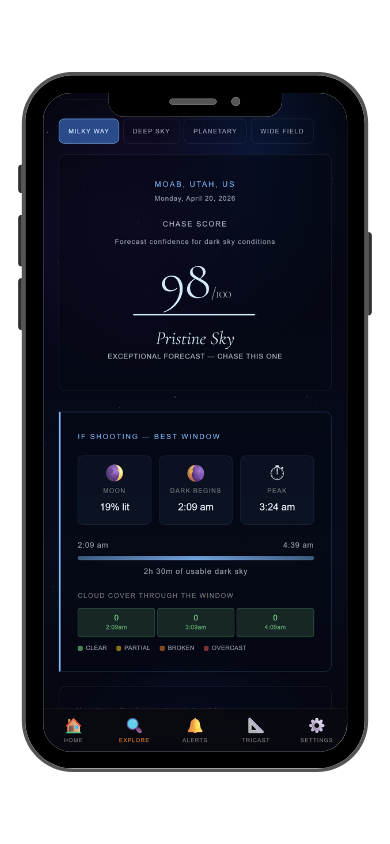
The live score above pulls today's forecast and runs it through StarCast's scoring model, factoring in cloud cover, moon illumination, Bortle class, humidity, and atmospheric transparency. Above 70 is an excellent night. Below 40, conditions are poor. The score updates daily.
What makes Kobuk Valley National Park good for astrophotography?
Kobuk Valley National Park lies entirely above the Arctic Circle in northwestern Alaska and is one of the least-visited national parks in the United States, seeing fewer than a few thousand visitors per year. With no roads, no services, and access only by bush plane, it achieves Bortle Class 1 skies of extraordinary purity. The park's most striking feature is the Great Kobuk Sand Dunes — 25 square miles of active sand dunes rising to 100 feet, an unexpected arctic desert landscape that has persisted since the last ice age. Photographing the northern lights reflected or silhouetted above the sand dunes in an arctic wilderness is a singular experience found nowhere else on Earth. The surrounding boreal forest, Kobuk River, and Brooks Range foothills add foreground variety.
When is the Milky Way visible at Kobuk Valley National Park?
Above the Arctic Circle, continuous daylight runs from late May through mid-July, eliminating any nighttime photography in that window. Darkness returns in late July, and the aurora season begins almost immediately. The galactic core is briefly visible in August and September. Aurora photography is the dominant pursuit from late July through April. Access by bush plane from Kotzebue requires advance planning and is subject to weather, and the park's extreme remoteness demands full wilderness self-sufficiency.