Frequently asked
Is tonight good for stargazing at Lake Powell?
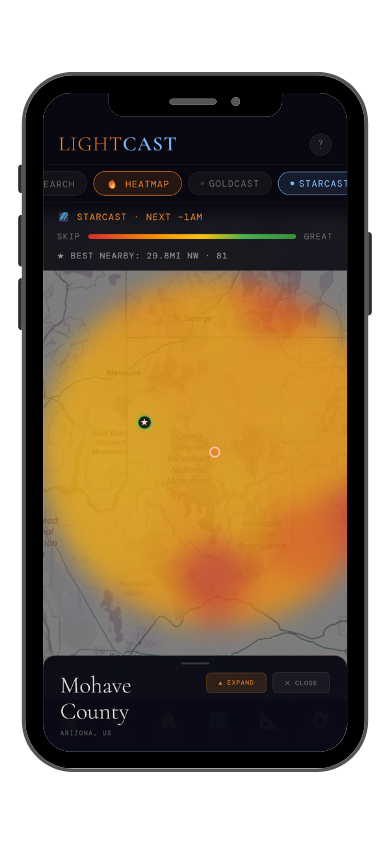
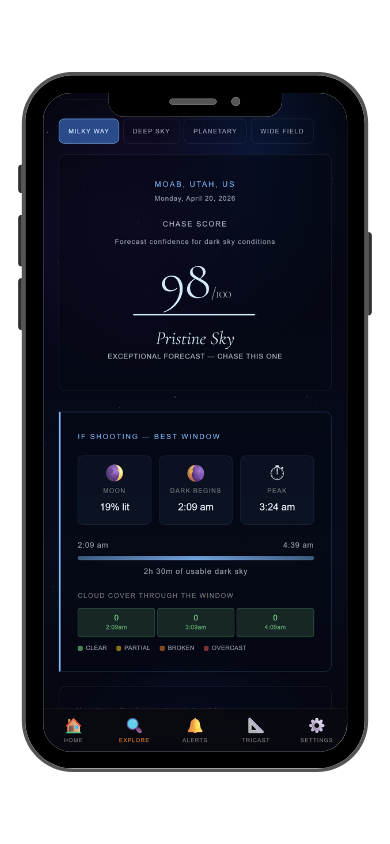
The live score above pulls today's forecast and runs it through StarCast's scoring model, factoring in cloud cover, moon illumination, Bortle class, humidity, and atmospheric transparency. Above 70 is an excellent night. Below 40, conditions are poor. The score updates daily.
What makes Lake Powell good for astrophotography?
Lake Powell sits at approximately 3,700 feet elevation on the Colorado Plateau in the Glen Canyon National Recreation Area, straddling the Arizona-Utah border. The surrounding desert is remote, with no major cities within a large radius. The lake itself creates a rare opportunity in the desert Southwest: water reflections of the Milky Way against canyon walls and sandstone formations. The area typically sees Bortle Class 2 conditions. The red rock canyon walls, slot canyon inlets, and open water provide foreground variety that few dark sky sites can match. Page, Arizona is the closest service town and has a small light dome, but moving even a few miles from town into the canyon system significantly reduces the impact.
When is the Milky Way visible at Lake Powell?
The galactic core is visible from March through October, with May through August being the peak window. The Colorado Plateau's dry climate and clear skies make the vast majority of nights workable. Summer brings the galactic center high in the southern sky and adds reflections off calm lake water, which is a signature look for Lake Powell astrophotography. Arizona does not observe daylight saving time, so sunset times shift less throughout the year than in neighboring states.