Frequently asked
Is tonight good for stargazing at Lake Tekapo?
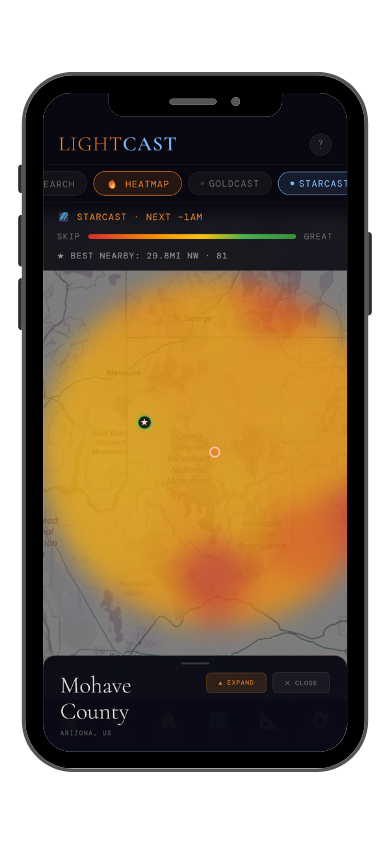
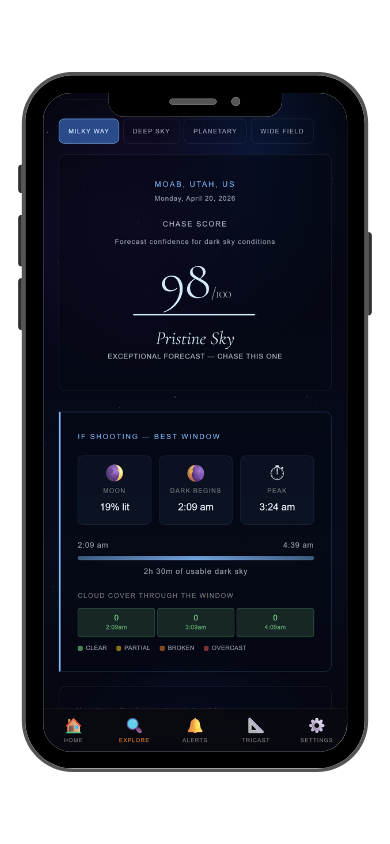
The live score above pulls today's forecast and runs it through StarCast's scoring model, factoring in cloud cover, moon illumination, Bortle class, humidity, and atmospheric transparency. Above 70 is an excellent night. Below 40, conditions are poor. The score updates daily.
What makes Lake Tekapo good for astrophotography?
Lake Tekapo sits within the Aoraki Mackenzie International Dark Sky Reserve, the largest dark sky reserve in the Southern Hemisphere. The lake itself is a vivid turquoise from glacial flour, and the Church of the Good Shepherd on its shore is one of the most photographed astrophotography foregrounds in the world. The Mackenzie Basin's dry, high-altitude climate and distance from major population centers produce Bortle Class 1 conditions across most of the reserve. The Southern Hemisphere sky adds objects invisible from northern latitudes: the Magellanic Clouds, the Southern Cross, and the galactic center rising high overhead in summer.
When is the Milky Way visible at Lake Tekapo?
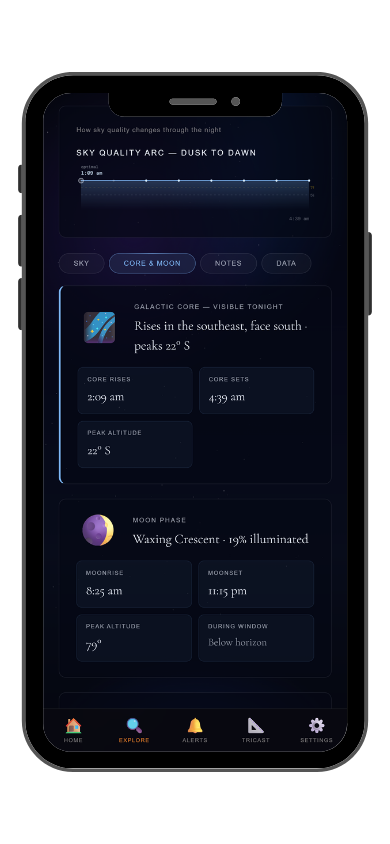
The galactic core is visible from roughly February through October in the Southern Hemisphere. Peak season runs from April through August, when the galactic center is highest in the sky during the long winter nights. June and July are especially productive: nights run 14 to 15 hours, the core transits near zenith, and the Mackenzie Basin's dry winter air produces exceptional transparency. The Church of the Good Shepherd is most accessible outside peak tourist hours, so arrive early or plan for a weeknight.