Frequently asked
Is tonight good for stargazing in Lander?
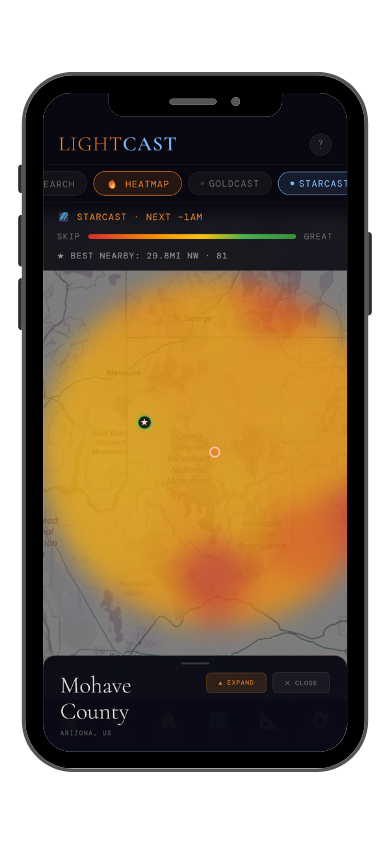
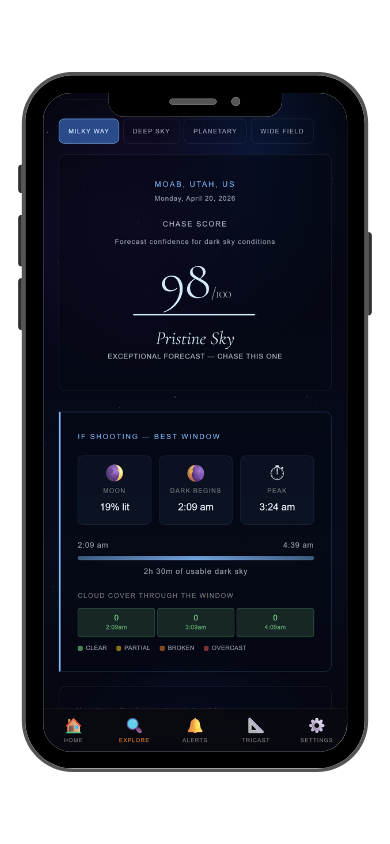
The live score above pulls today's forecast and runs it through StarCast's scoring model, factoring in cloud cover, moon illumination, Bortle class, humidity, and atmospheric transparency. Above 70 is an excellent night for astrophotography. Below 40, conditions are poor. The score updates daily.
What makes Lander good for astrophotography?
Lander sits at 5,400 feet in the Wind River valley at the eastern foot of the Wind River Range — the longest continuous mountain range in Wyoming and one of the most remote and glaciated in the lower 48. The Wind Rivers contain over 40 named glaciers and rise to Gannett Peak at 13,804 feet, the highest point in Wyoming. The range and the surrounding Shoshone National Forest deliver Bortle Class 2 skies within an easy drive, and the Wind River Indian Reservation extends the dark terrain across a vast, flat basin to the south and east. Sinks Canyon State Park just southwest of Lander — where the Popo Agie River disappears into a limestone cavern — is a distinctive local foreground. The combination of glacier-carved granite peaks, alpine lakes, and the vast empty Wind River Basin creates exceptional astrophotography conditions.
When is the Milky Way visible near Lander?
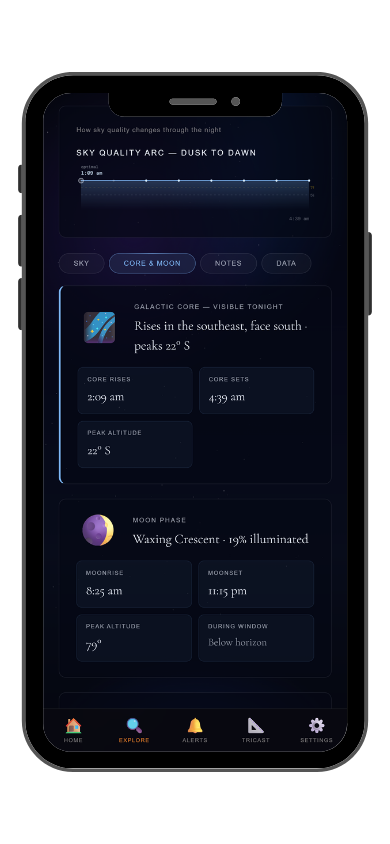
The galactic core is visible from late March through early October. The Wind River Range's high-country lakes and cirques are accessible on foot from Lander-area trailheads, with backpacking access opening in July after snowmelt. Prime astrophotography season runs May through September, though the best high-alpine shooting requires mid-July through September access when trails are reliably snow-free. Wyoming's continental climate means very stable, clear summer nights on the mountain slopes. The Wind River Basin east of Lander, with its open sagebrush plains and minimal light pollution, is an excellent ground-level option for wide Milky Way arch shots throughout the season.