Frequently asked
Is tonight good for stargazing in Lee Vining?
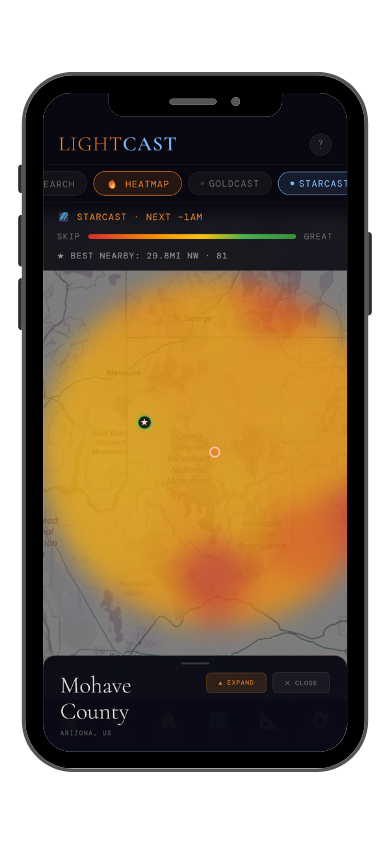
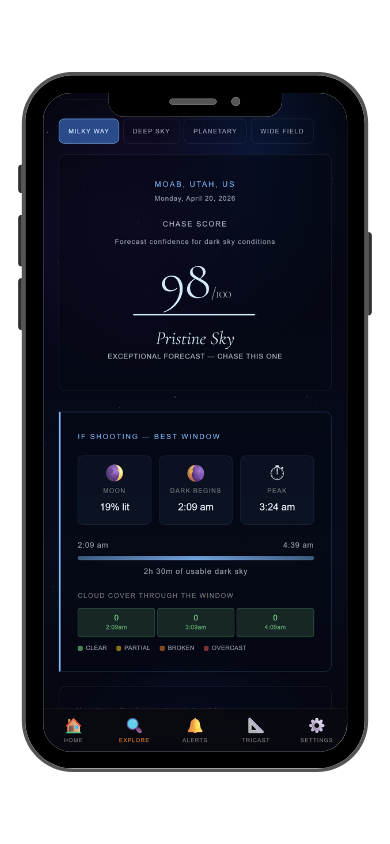
The live score above pulls today's forecast and runs it through StarCast's scoring model, factoring in cloud cover, moon illumination, Bortle class, humidity, and atmospheric transparency. Above 70 is an excellent night for astrophotography. Below 40, conditions are poor. The score updates daily.
What makes Lee Vining good for astrophotography?
Lee Vining is a small community of about 250 people at 6,800 feet on the eastern shore of Mono Lake — one of the most otherworldly night photography foregrounds in the United States. Mono Lake's ancient tufa towers — calcium carbonate spires rising from the alkaline lake surface — photograph dramatically against the Milky Way and are among the most recognized astrophotography subjects in the American West. The lake sits in a basin between the eastern Sierra Nevada and the Great Basin, and its Bortle Class 2 skies are among the darkest accessible by road in California. Lee Vining Canyon rises immediately west toward Tioga Pass at 9,945 feet and Yosemite National Park's Tuolumne Meadows, both offering high-elevation access to even darker conditions. The eastern Sierra's rain-shadow climate produces exceptional transparency and reliable clear nights.
When is the Milky Way visible near Lee Vining?
The galactic core is visible from late February through late October. Mono Lake is accessible year-round, and the tufa towers can be photographed in any season — winter provides a particularly stark and spectacular foreground with snow and ice in the surrounding desert landscape. Prime Milky Way season runs April through October, with June and July ideal for shooting the core rising directly above the tufa spires on the south shore. Tioga Pass and Yosemite open in late May or early June and close in autumn, adding high-alpine access during peak season. The eastern Sierra's climate reliability makes Lee Vining one of the most productive dark sky locations in California.