Frequently asked
Is tonight good for stargazing at Lençóis Maranhenses?
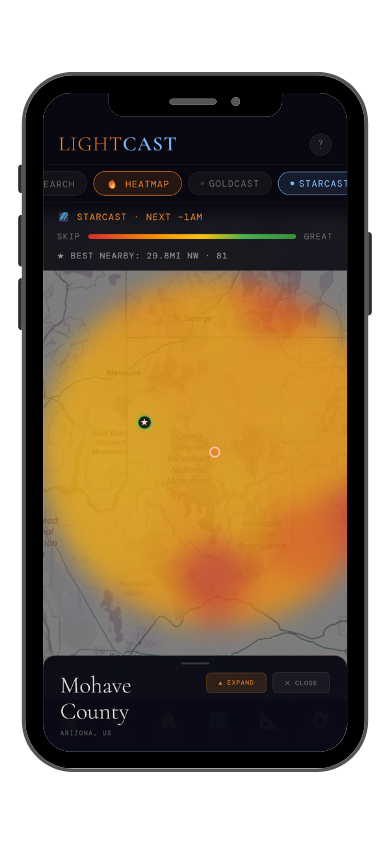
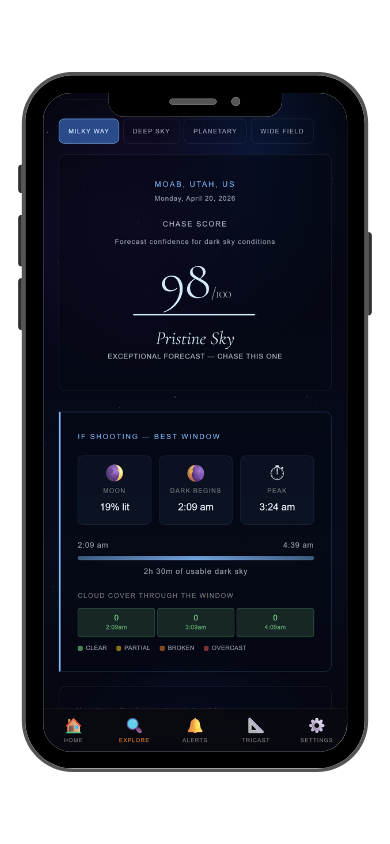
The live score above pulls today's forecast and runs it through StarCast's scoring model, factoring in cloud cover, moon illumination, Bortle class, humidity, and atmospheric transparency. Above 70 is an excellent night. Below 40, conditions are poor. The score updates daily.
What makes Lençóis Maranhenses good for astrophotography?
Lençóis Maranhenses National Park in the state of Maranhão in northeastern Brazil protects one of the most surreal landscapes on Earth — a vast field of white sand dunes stretching 70 kilometers along the Atlantic coast, punctuated between June and September by thousands of crystal-clear blue and green freshwater lagoons that fill the valleys between the dunes after the rainy season. The park sits near the equator in a remote coastal location, far from major Brazilian cities, achieving Bortle Class 2 to 3 skies. The combination of the white sand dunes, the turquoise lagoons reflecting the Milky Way, and the near-equatorial sky that places both northern and southern constellations in view creates one of the most visually extraordinary and logistically unique astrophotography environments in South America. There is simply nowhere else on Earth that looks like Lençóis Maranhenses at night.
When is the Milky Way visible at Lençóis Maranhenses?
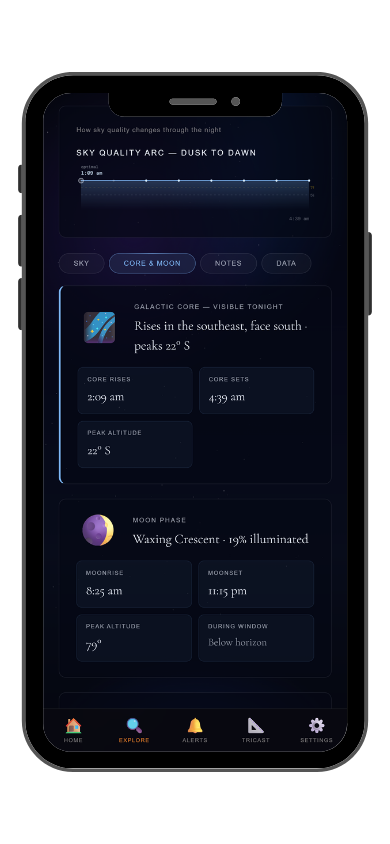
The galactic core is visible year-round at this near-equatorial Brazilian latitude, rising nearly overhead. The lagoons that make the park famous are fullest and most photogenic between June and September, following the rainy season from January through June. The dry season from July through December delivers the clearest nights and coincides with the period when the lagoons are most scenic — June through September is therefore the sweet spot that combines filled lagoons with improving clear sky frequency. Near the equator, both the Milky Way and southern sky features including the Magellanic Clouds and Southern Cross are accessible, providing a remarkable breadth of astronomical subjects from a single location.