Frequently asked
Is tonight good for stargazing in Los Alamos?
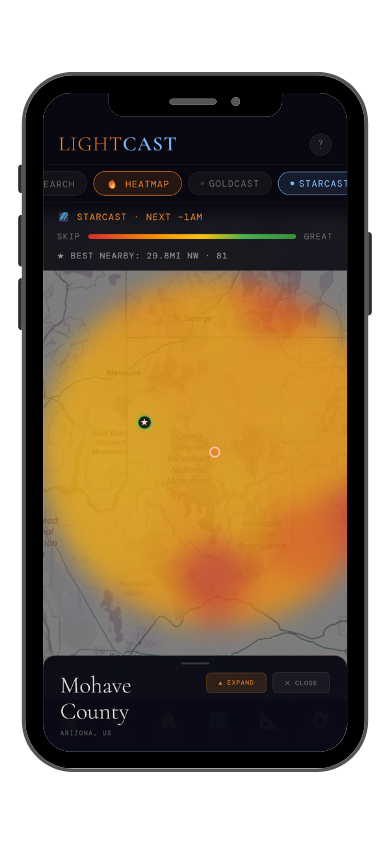
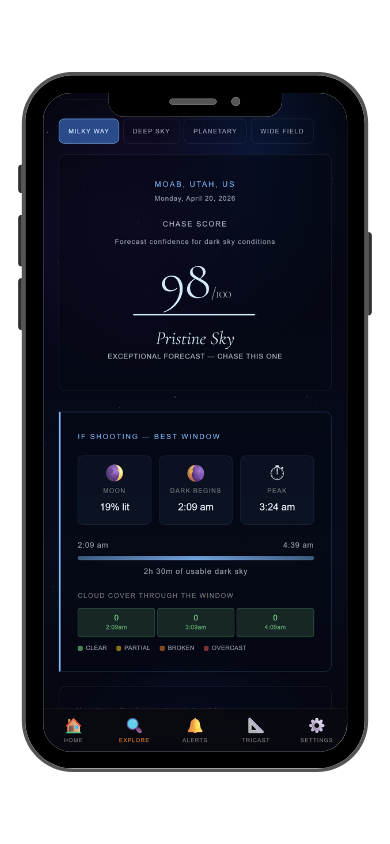
The live score above pulls today's forecast and runs it through StarCast's scoring model, factoring in cloud cover, moon illumination, Bortle class, humidity, and atmospheric transparency. Above 70 is an excellent night for astrophotography. Below 40, conditions are poor. The score updates daily.
What makes Los Alamos good for astrophotography?
Los Alamos sits at 7,300 feet on the Pajarito Plateau atop the Jemez Mountains in northern New Mexico, with the massive Valles Caldera — one of the largest calderas in North America — lying just to the west. The plateau drops into the Rio Grande canyon to the east, and the surrounding terrain is largely protected by the Santa Fe National Forest and federally restricted land associated with Los Alamos National Laboratory, meaning light encroachment is minimal in most directions. Bortle Class 2 to 3 skies exist practically at the edge of the mesa. The ponderosa-pine-covered ridges of the Jemez Mountains and the ancient caldera rim provide dramatic high-elevation foregrounds. The altitude and the dry mesa environment both contribute to outstanding atmospheric transparency for astrophotography.
When is the Milky Way visible in Los Alamos?
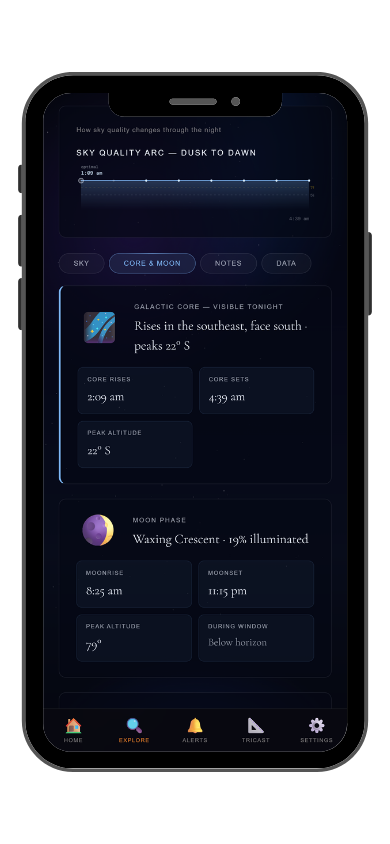
The galactic core is visible from late March through early October. Los Alamos's elevation of 7,300 feet puts it among the highest-altitude communities in New Mexico, and the surrounding wilderness and national laboratory security perimeter effectively create an unintentional dark sky preserve. Prime astrophotography season runs May through September. Monsoon season in July and August can bring afternoon and evening thunderstorms that clear to leave exceptional transparency by late night. The Valles Caldera, accessible on Valle Grande via Highway 4, is one of the most extraordinary wide-field Milky Way foregrounds in the country — a two-million-year-old volcanic crater filled with open meadow ringed by forested caldera walls.