Frequently asked
Is tonight good for stargazing at Los Glaciares National Park?
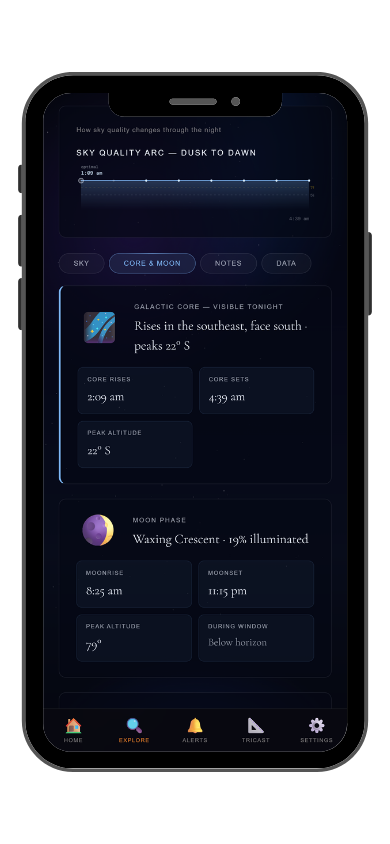
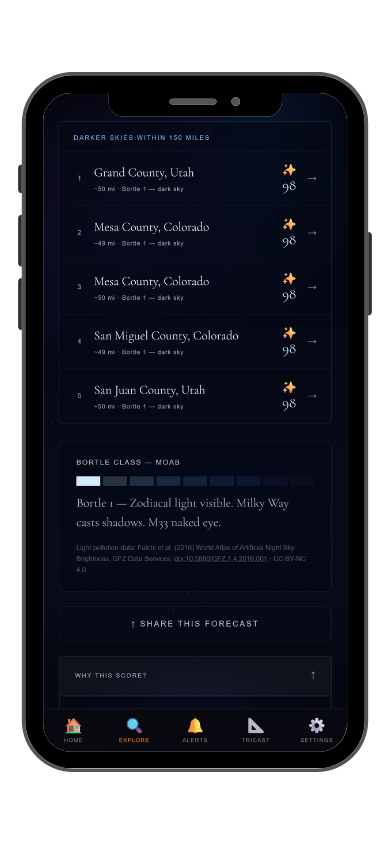
The live score above pulls today's forecast and runs it through StarCast's scoring model, factoring in cloud cover, moon illumination, Bortle class, humidity, and atmospheric transparency. Above 70 is an excellent night. Below 40, conditions are poor. The score updates daily.
What makes Los Glaciares National Park good for astrophotography?
Los Glaciares National Park in the Santa Cruz province of Argentine Patagonia is a UNESCO World Heritage Site protecting the largest expanse of ice outside the polar regions, including the famous Perito Moreno Glacier and the granite peaks of the Fitz Roy massif. At nearly 50 degrees south latitude, the park sits under Bortle Class 1 to 2 skies of exceptional quality, with the southern wilderness of both Chilean and Argentine Patagonia extending in all directions. The Fitz Roy and Cerro Torre spires above Lake Viedma and Lake Argentina are among the most dramatic mountain foreground subjects in the world for night photography, and the massive blue glacier faces and iceberg-dotted lakes add an otherworldly dimension to compositions under the southern Milky Way and Magellanic Clouds.
When is the Milky Way visible at Los Glaciares National Park?
The galactic core is visible year-round at this southern latitude, with the austral winter placing it highest in the sky. The main tourist season runs November through March, when austral summer brings longer days but extremely short nights. The shoulder seasons of October and April offer a better balance of accessible conditions and dark hours. Patagonian weather is famously extreme — wind, rapid weather changes, and cloud cover are constant factors. Aurora australis is occasionally visible from this latitude during periods of strong geomagnetic activity.