Frequently asked
Is tonight good for stargazing in Mammoth Lakes?
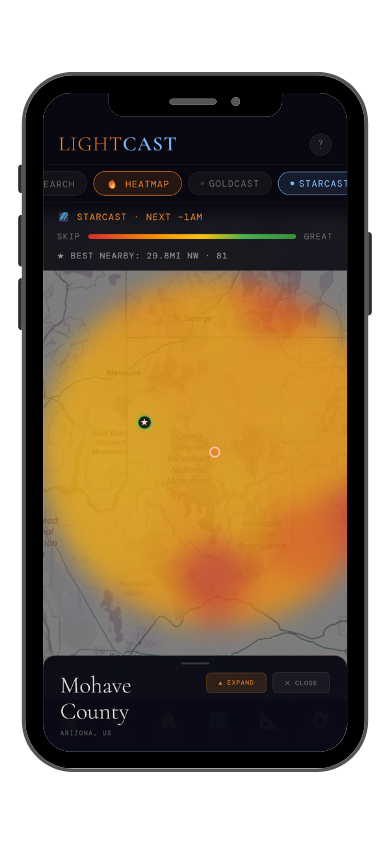
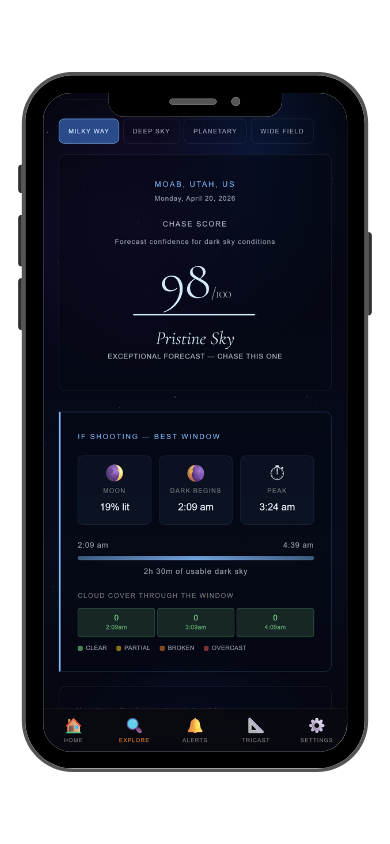
The live score above pulls today's forecast and runs it through StarCast's scoring model, factoring in cloud cover, moon illumination, Bortle class, humidity, and atmospheric transparency. Above 70 is an excellent night for astrophotography. Below 40, conditions are poor. The score updates daily.
What makes Mammoth Lakes good for astrophotography?
Mammoth Lakes sits at 7,900 feet on the eastern slope of the Sierra Nevada in the Long Valley Caldera region, surrounded by volcanic geology, alpine lakes, and the John Muir Wilderness. The town sits inside a dormant volcanic caldera and is bordered to the north by the Mammoth Lakes Basin — a cluster of pristine alpine lakes including Twin Lakes, Lake Mary, Lake George, and Lake Mamie — each offering dark reflections beneath high Sierra peaks. The Devils Postpile National Monument, 15 miles away, features a UNESCO-recognized formation of basalt columns as a distinctive geological foreground. Mammoth Mountain at 11,053 feet rises above town, and the eastern Sierra's rain-shadow position delivers very low humidity and reliable clear nights. Bortle Class 2 to 3 conditions are available at lake level immediately above the town.
When is the Milky Way visible near Mammoth Lakes?
The galactic core is visible from late February through late October. The Mammoth Lakes Basin lakes are typically accessible from late May through October. Devils Postpile is accessible by shuttle from late June through early September. Prime astrophotography season runs May through October, with July and August offering the best combination of lake access, high core altitude, and reliably clear Sierra Nevada nights. The Mammoth area receives significant winter snowfall, but the ski resort's extensive infrastructure and year-round accessibility make it an unusually well-served high-altitude dark sky base. New moon weekends in July are consistently the most competitive for lake-and-mountain compositions.