Frequently asked
Is tonight good for stargazing in Mariposa?
The live score above pulls today's forecast and runs it through StarCast's scoring model, factoring in cloud cover, moon illumination, Bortle class, humidity, and atmospheric transparency. Above 70 is an excellent night for astrophotography. Below 40, conditions are poor. The score updates daily.
What makes Mariposa good for astrophotography?
Mariposa sits at 1,950 feet in the Sierra Nevada foothills northwest of Oakhurst, on the main Highway 140 approach to Yosemite Valley's Arch Rock entrance. The town is a classic Gold Rush-era California foothill community with a small enough footprint that the surrounding hills and oak woodland quickly darken to Bortle Class 4 to 5 conditions. The key value of Mariposa as an astrophotography base lies in its access: it is one of the closest communities to Yosemite Valley's El Capitan Meadow and Tunnel View, both premier night photography locations. El Capitan's 3,000-foot granite face photographs magnificently at night, reflecting moonlight and catching the Milky Way above Yosemite Valley's glacier-carved profile. The Sierra National Forest surrounds the area for intermediate dark sky options. Yosemite remains one of the most in-demand astrophotography destinations in the world.
When is the Milky Way visible near Mariposa?
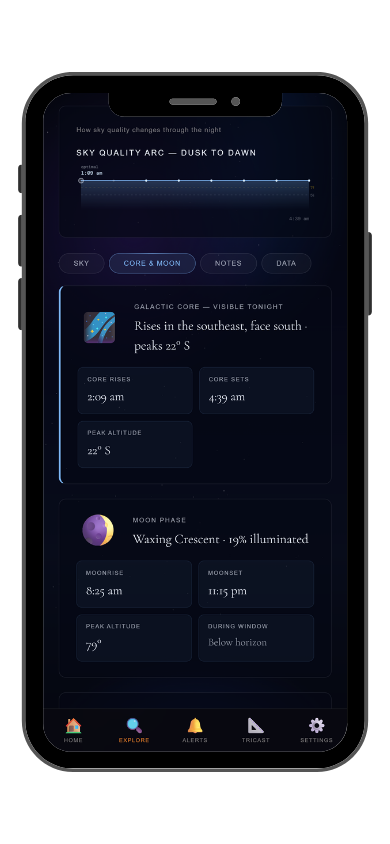
The galactic core is visible from late February through late October. Yosemite Valley is accessible year-round but subject to reservation requirements that fluctuate with season — checking the park's day-use reservation system before planning is essential. The Milky Way rises in the southeast and arcs across the southern sky during peak season, framing above El Capitan and Half Dome when shooting from Yosemite Valley's meadows. Prime astrophotography season runs April through October. The valley floor's lower elevation means more humidity than Glacier Point or Tuolumne Meadows, but the intimate granite wall scale is unmatched. New moon windows in June and July are the most sought after for valley compositions.