Frequently asked
Is tonight good for stargazing at Massacre Rim?
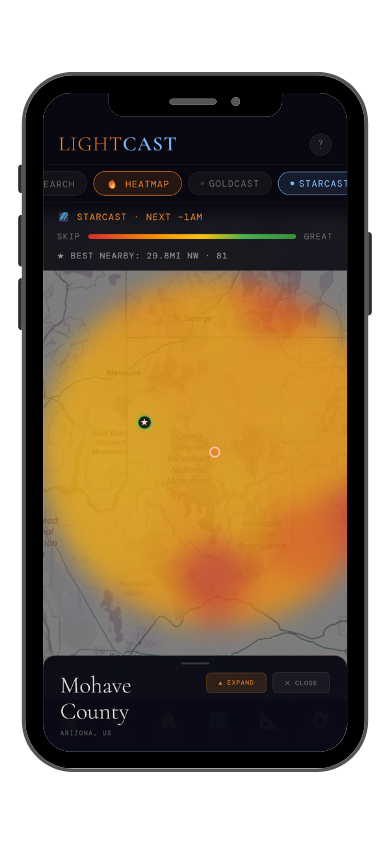
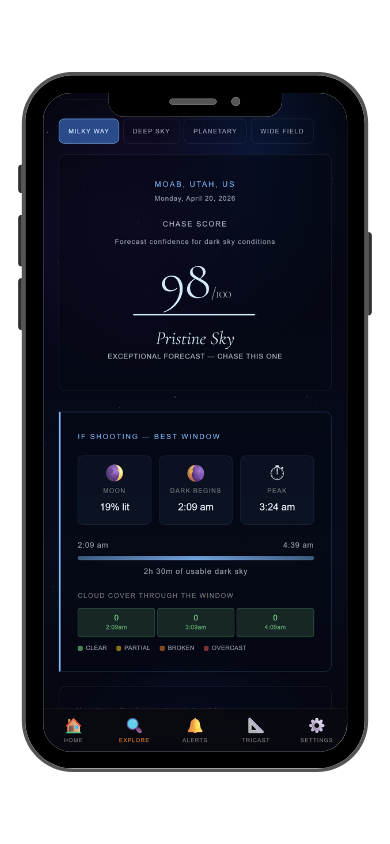
The live score above pulls today's forecast and runs it through StarCast's scoring model, factoring in cloud cover, moon illumination, Bortle class, humidity, and atmospheric transparency. Above 70 is an excellent night. Below 40, conditions are poor. The score updates daily.
What makes Massacre Rim good for astrophotography?
Massacre Rim is a certified International Dark Sky Sanctuary in the far northwestern corner of Nevada, more than 150 miles north of Reno. It is one of only a handful of Dark Sky Sanctuaries in the world and is consistently cited as one of the darkest locations in the continental United States. Elevations across the sanctuary range from 5,600 to nearly 7,000 feet. A 1,200-foot fault escarpment along the western edge descends dramatically into Long Valley, providing protective topography that blocks distant light sources. The sanctuary encompasses two volcanic plateaus surrounded by wide valley floors, creating open sky in all directions. Primitive BLM camping is permitted with no fees. Access requires a high-clearance 4WD vehicle on rough rocky roads.
When is the Milky Way visible at Massacre Rim?
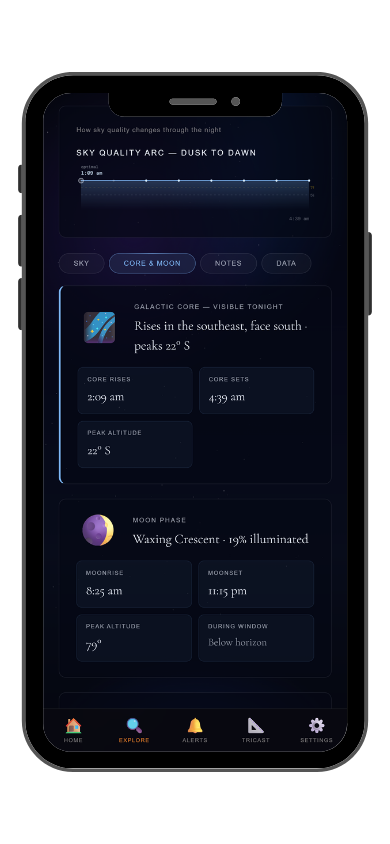
The galactic core is visible from April through October, with July being the peak month when Sagittarius and Scorpius reach their highest points in the sky. The high desert climate delivers consistently clear skies and low humidity outside of occasional winter storms. This is one of the most remote accessible dark sky sites in the lower 48, so plan fuel and supplies carefully: the nearest significant services are hours away. On the darkest moonless nights, the Milky Way casts visible shadows on the ground here.