Frequently asked
Is tonight good for stargazing at Mauna Kea?
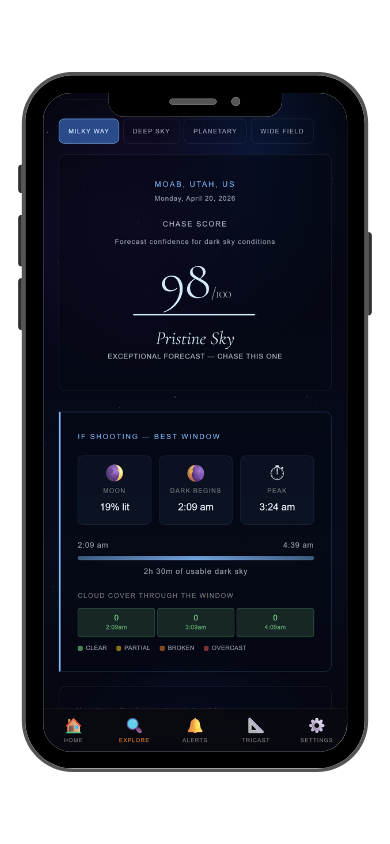
The live score above pulls today's forecast and runs it through StarCast's scoring model, factoring in cloud cover, moon illumination, Bortle class, humidity, and atmospheric transparency. Above 70 is an excellent night. Below 40, conditions are poor. The score updates daily.
What makes Mauna Kea good for astrophotography?
Mauna Kea stands at 13,796 feet on the Big Island of Hawaii, placing it above roughly 40% of Earth's atmosphere and 90% of its water vapor. The summit rates Bortle Class 1, the darkest classification possible. More than thirteen major observatories from a dozen countries operate here, making it one of the most scientifically significant astronomical sites on Earth. The Visitor Information Station at 9,200 feet is open to the public and offers exceptional viewing conditions, with most nights placing you above the cloud layer. The surrounding Pacific Ocean ensures no significant light sources exist for hundreds of miles in any direction. Note: the summit road beyond the Visitor Station requires a 4WD vehicle and closes to visitors 30 minutes after sunset.
When is the Milky Way visible at Mauna Kea?
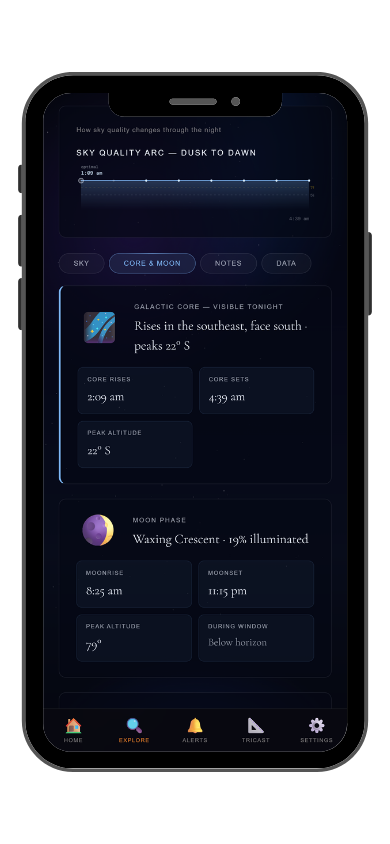
The galactic core is visible from approximately February through September. Hawaii's latitude of 19°N means the galactic center rises relatively high in the southern sky during summer, giving excellent shooting angles. Cloud cover is the primary variable to watch. The summit typically sits above the cloud layer on most nights, but the approach road and Visitor Station can be fogged in. Check the Mauna Kea Weather Hotline at (808) 935-6268 before making the drive up.