Frequently asked
Is tonight good for stargazing near Missoula?
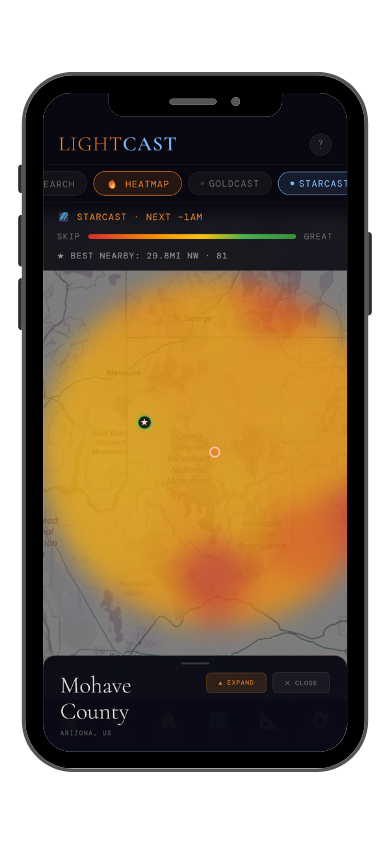
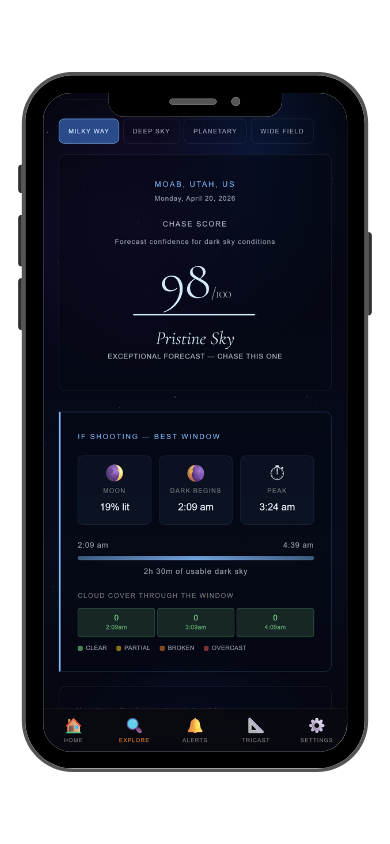
The live score above pulls today's forecast and runs it through StarCast's scoring model, factoring in cloud cover, moon illumination, Bortle class, humidity, and atmospheric transparency. Above 70 is an excellent night. Below 40, conditions are poor. The score updates daily.
What makes the Missoula area good for astrophotography?
Missoula sits at 3,209 feet in a valley surrounded by the Rattlesnake Wilderness, Lolo National Forest, and the Bitterroot Range. The city produces a moderate light dome but is hemmed in by mountains that contain the glow. Driving 15 to 30 minutes in almost any direction into the surrounding national forest quickly reaches Bortle Class 3 or better. The Rattlesnake Wilderness directly northeast of town, the Bitterroot Valley to the south, and the Blackfoot River corridor to the northeast all provide accessible dark sky access with Montana mountain foregrounds. The area's proximity to the Bob Marshall Wilderness, one of the largest wilderness complexes in the lower 48, means genuinely dark Bortle Class 1 to 2 skies are within a reasonable drive.
When is the Milky Way visible near Missoula?
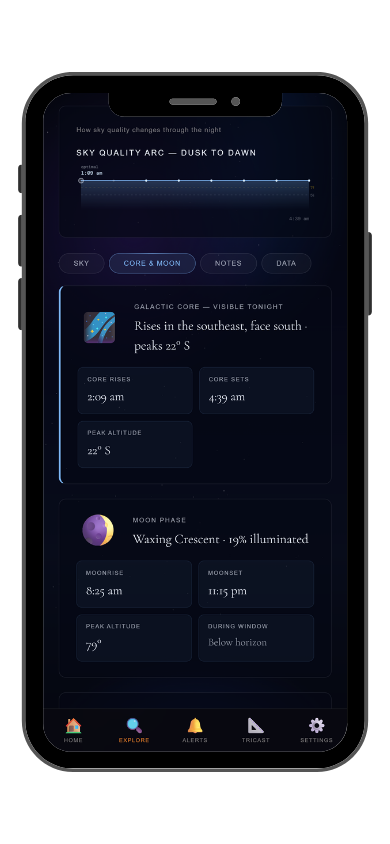
The galactic core is visible from April through October, with June through August producing the best positioning. Western Montana can be cloudier than eastern Montana due to Pacific moisture coming over the Cascades, so checking the forecast matters more here than in drier mountain states. Fall tends to bring clearer, colder nights. Wildfire smoke from August through September is a recurring consideration that can significantly reduce atmospheric transparency.