Frequently asked
Is tonight good for stargazing at Monahans Sandhills?
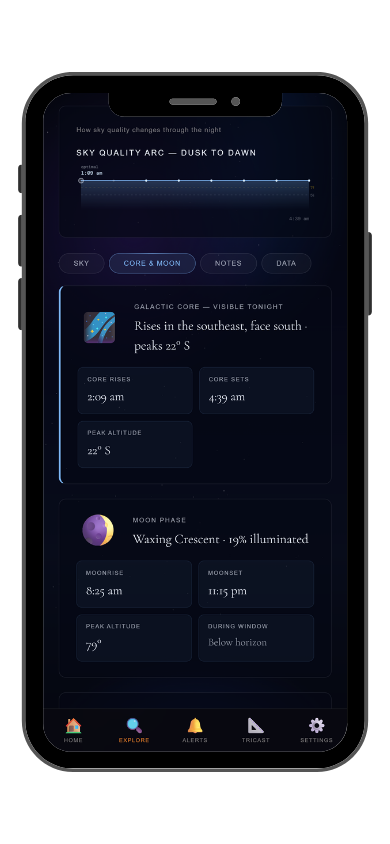
The live score above pulls today's forecast and runs it through StarCast's scoring model, factoring in cloud cover, moon illumination, Bortle class, humidity, and atmospheric transparency. Above 70 is an excellent night. Below 40, conditions are poor. The score updates daily.
What makes Monahans Sandhills good for astrophotography?
Monahans Sandhills State Park preserves 3,840 acres of wind-shaped sand dunes in the Permian Basin of west Texas. The dunes rise up to 70 feet and shift over time, creating a constantly changing landscape with smooth curved ridgelines that photograph well in both moonlight and pure darkness. The surrounding Permian Basin is rural enough that light pollution is limited: Midland and Odessa are about 45 miles north, producing a moderate glow, but the south and west horizons are nearly pristine with Bortle Class 2 to 3 conditions.
When is the Milky Way visible at Monahans Sandhills?
The galactic core is visible from March through October. West Texas stays clear and dry through most of the season. Wind is a factor at this location: calm nights allow smooth dune ridge compositions, while gusty nights can introduce sand haze near the surface. The best shooting is in May through July when the core rises high enough to clear the southern horizon well before midnight and the nights are still long enough for full core visibility.