Frequently asked
Is tonight good for stargazing at Mont-Mégantic?
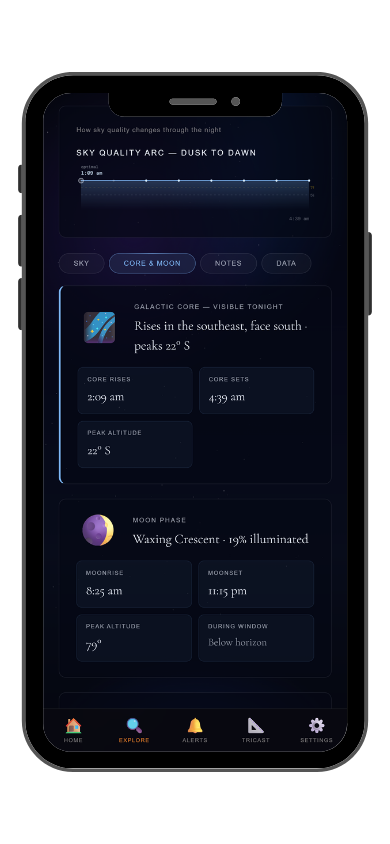
The live score above pulls today's forecast and runs it through StarCast's scoring model, factoring in cloud cover, moon illumination, Bortle class, humidity, and atmospheric transparency. Above 70 is an excellent night. Below 40, conditions are poor. The score updates daily.
What makes Mont-Mégantic good for astrophotography?
Mont-Mégantic National Park in the Eastern Townships of Quebec is home to the first International Dark Sky Reserve created in the world, established in 2007 around the Observatoire du Mont-Mégantic. The park and surrounding municipalities cooperate to limit light pollution across a 5,000 square kilometer zone, making it a model for dark sky protection globally. The 1,105-meter summit observatory is open for public visits, and the reserve's forests, wetlands, and mountain terrain give a distinctly Québécois character to night photography. Sherbrooke is 50 kilometers to the west, and the surrounding Appalachian hills absorb most of its light.
When is the Milky Way visible at Mont-Mégantic?
The galactic core is visible from April through October. Summer (June through August) brings the most active Milky Way visibility, with the core in the south from midnight onward. Quebec's summer weather can be humid, which affects transparency, but the mountain elevation helps. Late summer (August through September) often brings the best combination of low humidity, long nights, and good core position. Winter visits offer aurora potential and deep-sky constellation photography above the snow-covered Appalachian summit, with the observatory dome as foreground.