Frequently asked
Is tonight good for stargazing in Montrose?
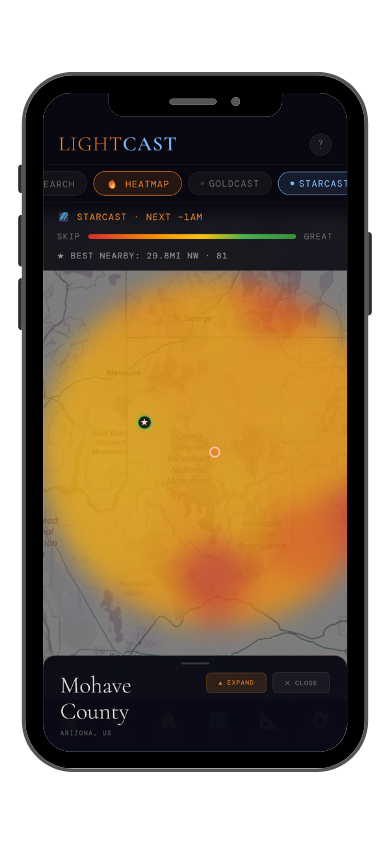
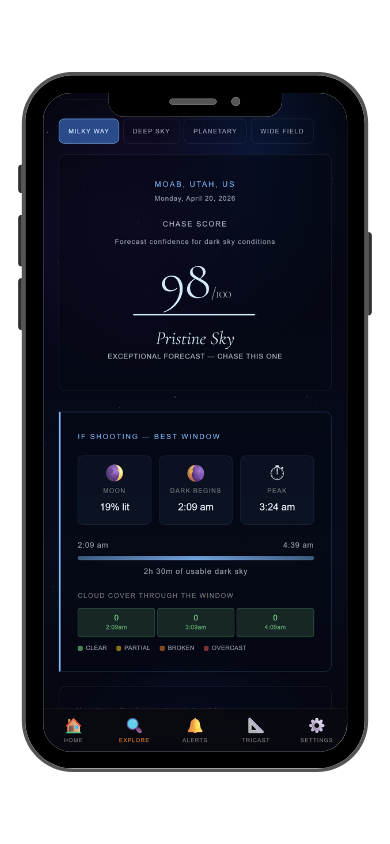
The live score above pulls today's forecast and runs it through StarCast's scoring model, factoring in cloud cover, moon illumination, Bortle class, humidity, and atmospheric transparency. Above 70 is an excellent night for astrophotography. Below 40, conditions are poor. The score updates daily.
What makes Montrose good for astrophotography?
Montrose sits at 5,800 feet on Colorado's Western Slope, positioned between Black Canyon of the Gunnison National Park to the east and the Uncompahgre Plateau to the west. Black Canyon is a certified International Dark Sky Park with Bortle Class 2 skies — the inner canyon is one of the most dramatic natural foregrounds in Colorado, with sheer 2,000-foot walls of Precambrian gneiss plunging toward the Gunnison River below. The park's South Rim is just 15 miles from Montrose and is widely regarded as one of the premier Milky Way photography locations in the Rocky Mountain region. The Uncompahgre Plateau to the west is equally dark and offers forest terrain with wide open ridgelines. Montrose's arid, high-desert climate produces more clear nights than the higher mountains to the east, making it a reliable astrophotography base.
When is the Milky Way visible near Montrose?
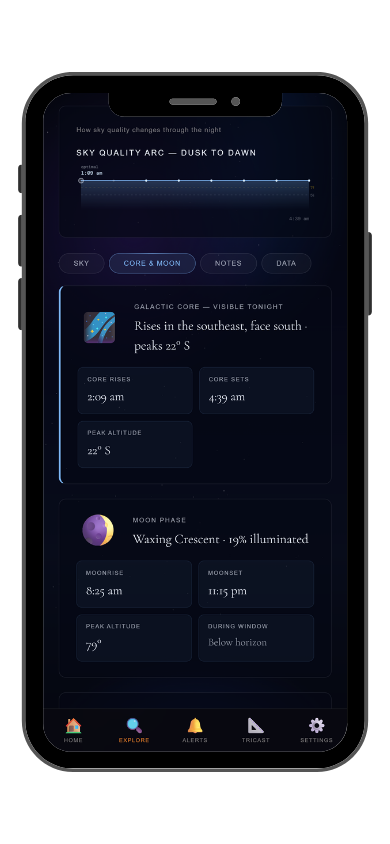
The galactic core is visible from late March through early October. Black Canyon of the Gunnison offers some of the best Milky Way conditions in Colorado — the canyon's extreme depth and darkness make it one of the premier night photography foregrounds in the Rockies. Prime season runs May through September, with June and July ideal for shooting the core directly above the canyon rim. Colorado's typical summer monsoon pattern in July and August can bring afternoon storms, but the Western Slope dries out faster than the high-country passes to the east, and clear nights at Black Canyon are common even in monsoon season.