Frequently asked
Is tonight good for stargazing at Mount Cook?
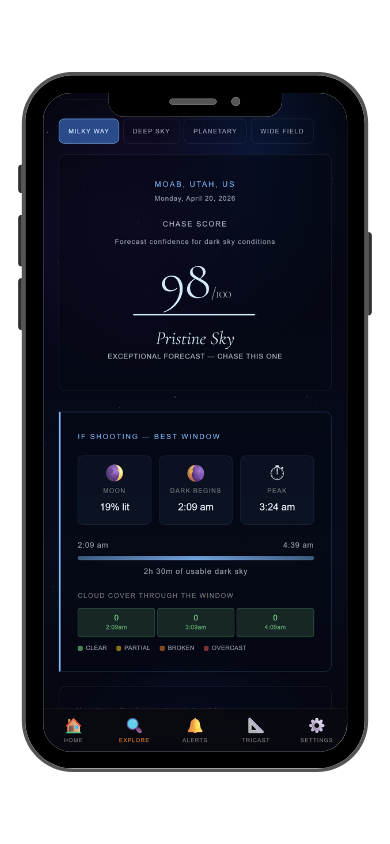
The live score above pulls today's forecast and runs it through StarCast's scoring model, factoring in cloud cover, moon illumination, Bortle class, humidity, and atmospheric transparency. Above 70 is an excellent night. Below 40, conditions are poor. The score updates daily.
What makes Mount Cook good for astrophotography?
Aoraki/Mount Cook National Park shares the Aoraki Mackenzie International Dark Sky Reserve with Lake Tekapo and offers a dramatically different foreground: New Zealand's highest peak at 3,724 meters, surrounded by glaciers and the Hooker Valley. The Hooker Lake at the end of the valley trail is one of the most striking night sky compositions in the country, with the snow-capped peak framing the galactic center on clear nights. Light pollution is effectively zero in every direction from the Hermitage area, and the dry foehn wind that occasionally sweeps in from the west produces some of the clearest and most transparent skies in the Southern Hemisphere.
When is the Milky Way visible at Mount Cook?
The galactic core is visible from February through October. Winter (June through August) offers the longest nights and the highest galactic center altitude, but access to higher trailheads can be restricted by snow and ice. The Hooker Valley Track is accessible year-round and is the standard night photography route. Autumn (March through May) is often the most balanced season: the core is well-placed, nights are long enough, and weather is more stable than winter. Mountain weather changes rapidly, so always check conditions before heading out.