Frequently asked
Is tonight good for stargazing at Mount Shasta?
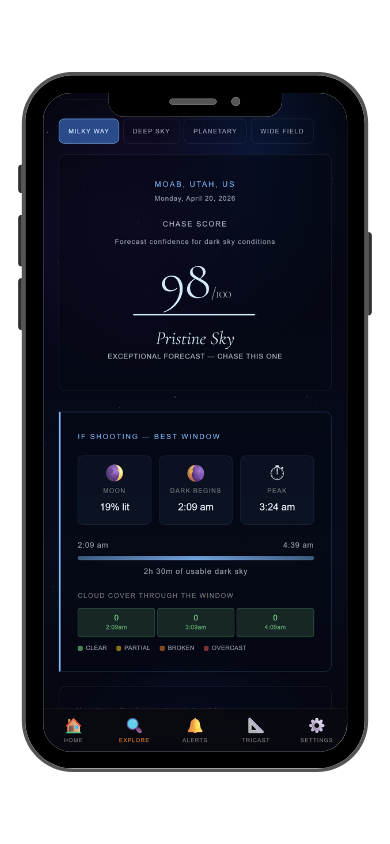
The live score above pulls today's forecast and runs it through StarCast's scoring model, factoring in cloud cover, moon illumination, Bortle class, humidity, and atmospheric transparency. Above 70 is an excellent night. Below 40, conditions are poor. The score updates daily.
What makes Mount Shasta good for astrophotography?
Mount Shasta is a 14,179-foot stratovolcano rising in near-total isolation from the surrounding Cascade landscape in far northern California. Its symmetrical snow-capped cone is one of the most recognizable silhouettes on the West Coast, and it photographs dramatically against the Milky Way from multiple directions. Shasta City at the base is small, and the surrounding Shasta-Trinity National Forest is undeveloped for many miles in most directions. Bunny Flat at 6,950 feet on the south slope is the standard shooting position: close to the mountain, away from town light, and accessible by paved road.
When is the Milky Way visible at Mount Shasta?
The galactic core is visible from March through October. Northern California's Coast Range to the west blocks Pacific storm systems, and Shasta typically enjoys clear nights from May through September. The mountain creates its own weather, and lenticular cloud caps are common, which can be either an obstacle or a dramatic foreground element depending on timing. For clean mountain silhouette shots, the galactic core rises in the southeast from mid-May onward and can be framed against the east or southeast face of the peak.