Frequently asked
Is tonight good for stargazing at Muddus National Park?
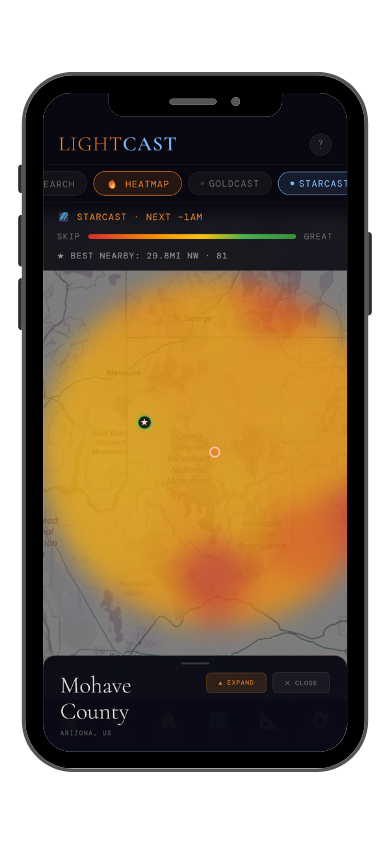
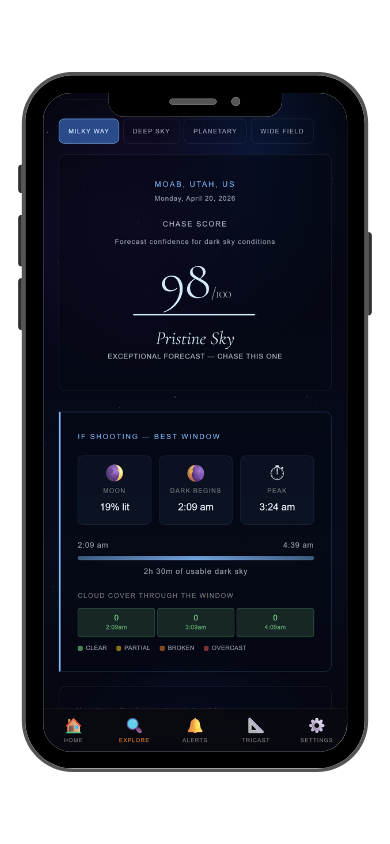
The live score above pulls today's forecast and runs it through StarCast's scoring model, factoring in cloud cover, moon illumination, Bortle class, humidity, and atmospheric transparency. Above 70 is an excellent night. Below 40, conditions are poor. The score updates daily.
What makes Muddus National Park good for astrophotography?
Muddus National Park in Swedish Lapland lies above the Arctic Circle, forming part of the Laponian Area — a UNESCO World Heritage Site encompassing some of the largest unspoiled wilderness in Europe. The park protects a vast primeval boreal forest of ancient pine and birch, wetland bogs, and the dramatic Muddus river gorge. Its position in the Swedish Arctic far from any significant population center delivers Bortle Class 1 to 2 skies of exceptional quality, with zero artificial light interference across the full horizon. The ancient forest, gorge landscapes, and Sami cultural heritage of the region give the landscape particular depth. At this latitude, the aurora borealis is one of the most frequent and spectacular in the world — visible on most clear nights from August through April.
When is the Milky Way visible at Muddus National Park?
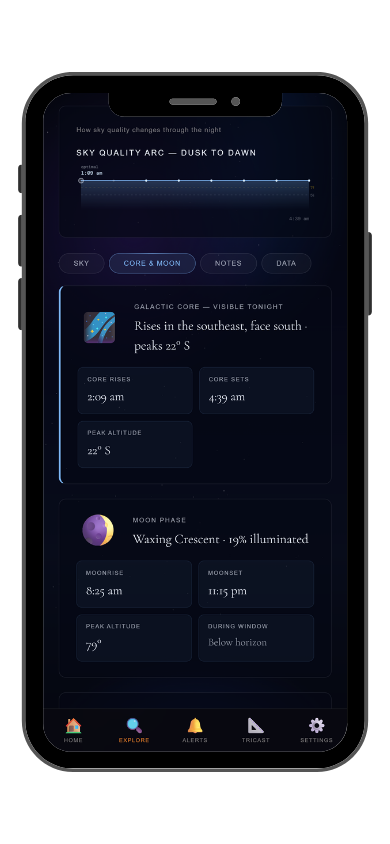
Above the Arctic Circle, continuous daylight runs from late May through mid-July, eliminating nighttime photography entirely in that window. Darkness returns rapidly in late July, and the aurora season begins almost immediately. The galactic core is briefly visible in August and September before dropping below the horizon for the remainder of the season. Aurora photography is the defining night sky pursuit at Muddus, running from late July through April with extraordinary frequency and intensity. Winter access into the park's interior requires skis or snowshoes, and temperatures can fall to -30°C or below — thorough preparation is essential.