Frequently asked
Is tonight good for stargazing at New River Gorge National Park?
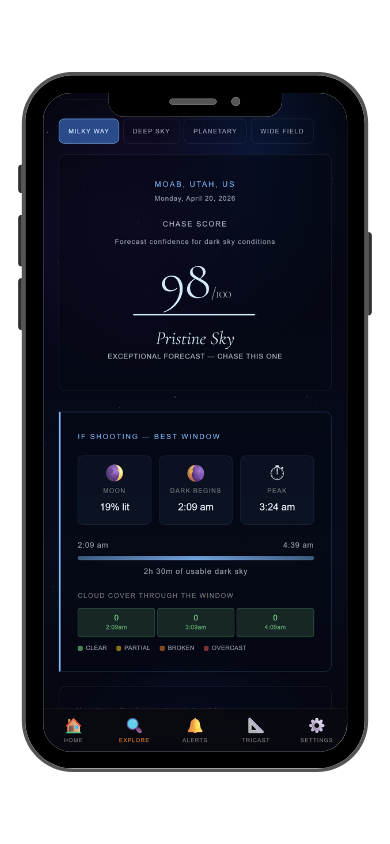
The live score above pulls today's forecast and runs it through StarCast's scoring model, factoring in cloud cover, moon illumination, Bortle class, humidity, and atmospheric transparency. Above 70 is an excellent night. Below 40, conditions are poor. The score updates daily.
What makes New River Gorge National Park good for astrophotography?
New River Gorge National Park in the mountains of southern West Virginia became the United States' newest national park in 2020, protecting a dramatic gorge carved by one of the oldest rivers in North America. The surrounding Appalachian highlands are among the least light-polluted landscapes in the eastern US, with Bortle Class 3 to 4 skies accessible in the gorge's more remote sections. The iconic New River Gorge Bridge — the longest steel arch bridge in the Western Hemisphere — is one of the most dramatic man-made foreground subjects for astrophotography in the eastern United States. The forested gorge walls, river rapids, and historic coal-mining remnants provide additional foreground variety that is distinctively Appalachian.
When is the Milky Way visible at New River Gorge National Park?
The galactic core is visible from April through October, peaking in July and August. West Virginia's mountain climate brings frequent cloud cover, particularly in summer, and humidity can reduce transparency even on clear nights. Fall is generally the most reliable season for clear skies, and the autumn foliage combined with the Milky Way over the bridge is a compelling combination. Bridge Day, held each October, draws massive crowds but is followed by quiet fall nights that are among the best of the year.