Frequently asked
Is tonight good for stargazing at North Cascades National Park?
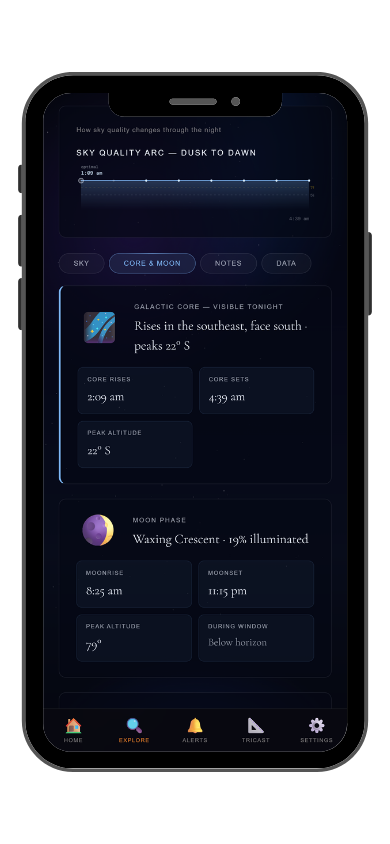
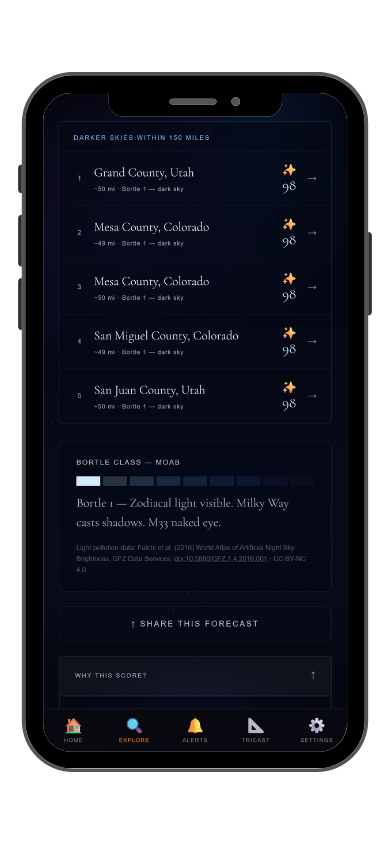
The live score above pulls today's forecast and runs it through StarCast's scoring model, factoring in cloud cover, moon illumination, Bortle class, humidity, and atmospheric transparency. Above 70 is an excellent night. Below 40, conditions are poor. The score updates daily.
What makes North Cascades National Park good for astrophotography?
North Cascades National Park is one of the least-visited national parks in the contiguous United States, protecting a vast wilderness of glaciated peaks, alpine lakes, and dense old-growth forest in the northern Washington Cascades. Its remoteness from the Seattle metro area and the mountain range's shielding effect produce Bortle Class 2 to 3 skies in the park's backcountry. The landscape of jagged peaks reflected in glacial tarns and the Skagit River valley below provides exceptional foreground. At this northern latitude, summer nights are extremely short but aurora activity is a realistic possibility from fall through spring, with the peaks providing dramatic frames for the northern lights.
When is the Milky Way visible at North Cascades National Park?
The galactic core is visible from April through October, but the very short nights of summer near the 49th parallel limit true astronomical darkness to a narrow window around midnight in June and July. September and October offer the best combination of dark hours and galactic visibility before the heavy fall rain season arrives. The park's western slopes receive among the highest precipitation in the contiguous US, so weather windows must be planned carefully. Aurora activity is a seasonal highlight from October through March.