Frequently asked
Is tonight good for stargazing at Olympic?
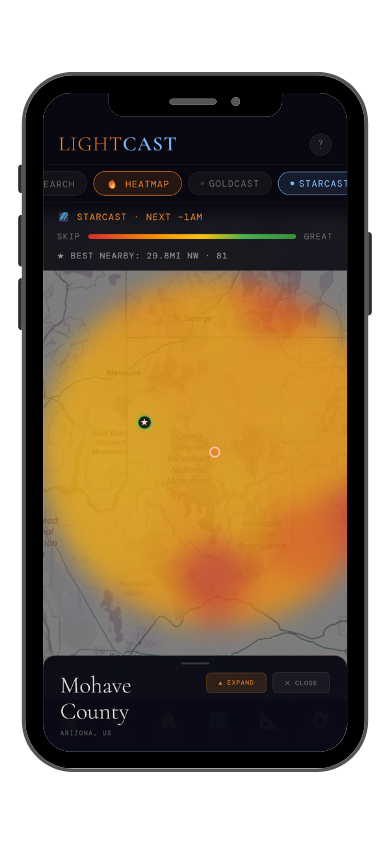
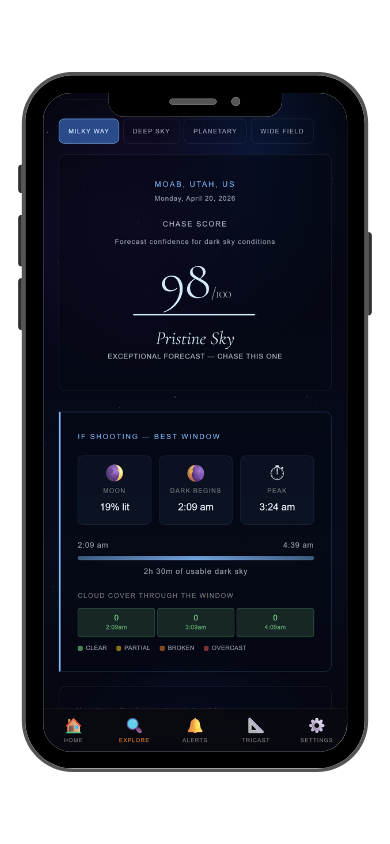
The live score above pulls today's forecast and runs it through StarCast's scoring model, which factors in cloud cover, moon illumination, Bortle class, humidity, and atmospheric transparency. Above 70 is an excellent night. Below 40, conditions are poor. The score updates daily.
What makes Olympic good for astrophotography?
Olympic is one of the few places in the contiguous US where you can photograph the Milky Way over old-growth rainforest, alpine ridgelines, and Pacific coastline all within the same park. Hurricane Ridge sits above the marine cloud layer on clear nights, offering dark skies above the fog. The Hoh Rainforest and the coastal wilderness sections near Ruby Beach and Rialto Beach give you sea stacks as foreground under the stars. The park is a certified Dark Sky Park and among the darkest accessible locations in the Pacific Northwest.
When is the Milky Way visible at Olympic?
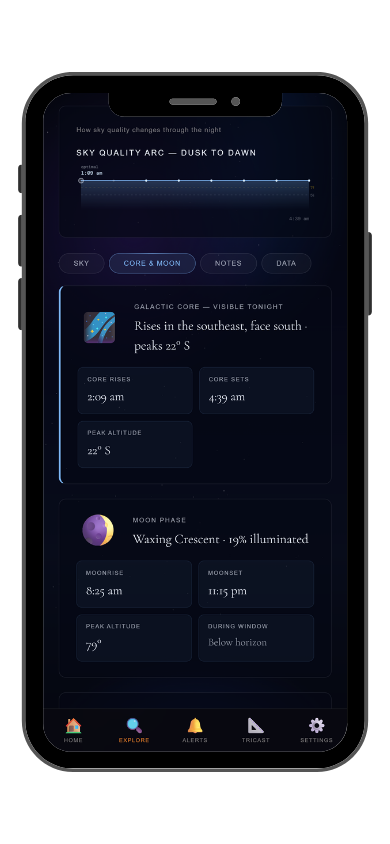
The galactic core is technically visible from April through September, but the Pacific Northwest's cloud cover makes timing critical. July and August offer the highest probability of clear nights, especially above 4,000 feet at Hurricane Ridge. Coastal locations are more cloud-prone but occasionally clear dramatically after a front passes through. Checking the 48-hour forecast closely before committing to a drive is essential at Olympic.