Frequently asked
Is tonight good for stargazing in Page?
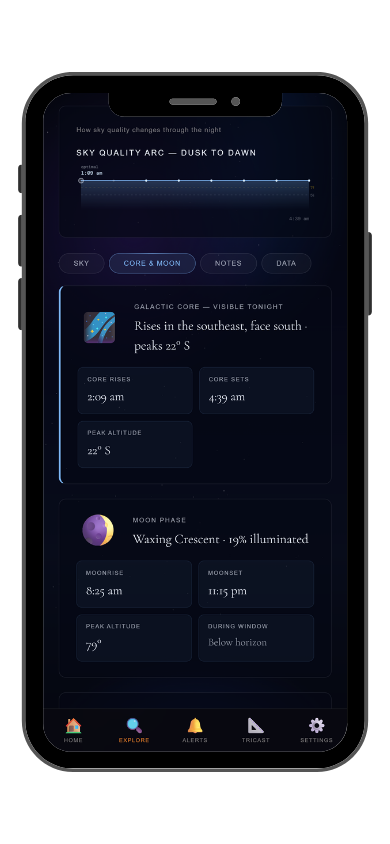
The live score above pulls today's forecast and runs it through StarCast's scoring model, factoring in cloud cover, moon illumination, Bortle class, humidity, and atmospheric transparency. Above 70 is an excellent night for astrophotography. Below 40, conditions are poor. The score updates daily.
What makes Page good for astrophotography?
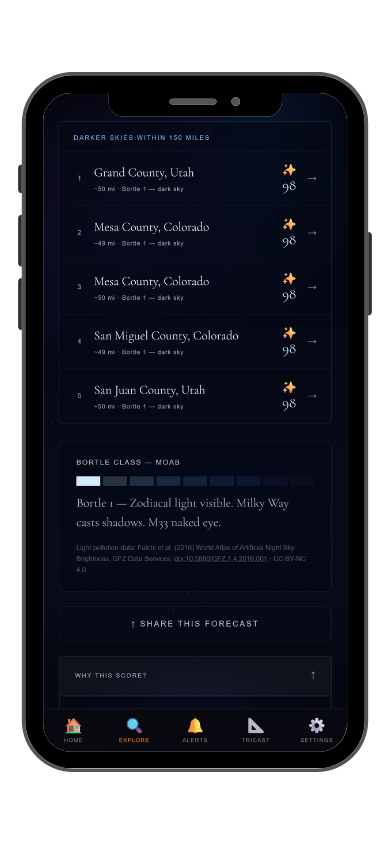
Page, Arizona sits on the Colorado Plateau at 4,300 feet on the shore of Lake Powell, surrounded by some of the most photographed sandstone geology on the continent. The dark sky overhead is Bortle Class 2 to 3 — among the darkest in the Southwest — and the foreground options are nearly unmatched. Antelope Canyon, Horseshoe Bend, and the sweeping red cliffs above Lake Powell are all within a short drive. The canyon slot formations at Antelope Canyon are used by photographers to frame stars and the Milky Way above the narrow sandstone walls. Horseshoe Bend's 270-degree river curve is one of the most recognized Milky Way compositions in the American West. Arizona does not observe daylight saving time, simplifying planning. Light pollution is minimal in all directions, and the plateau elevation keeps the atmosphere thin and transparent.
When is the Milky Way visible in Page?
The galactic core is visible from approximately late February through late October, rising in the southeast and reaching useful altitude by April. The core is highest in the sky during June and July, which also offer the darkest nights given Page's desert latitude. Monsoon moisture arrives in July and August and can introduce cloud cover, but storms are often convective — building in the afternoon and clearing by late night — leaving excellent transparency after midnight. New moon windows from April through October are the prime targets for Milky Way astrophotography at Horseshoe Bend and Antelope Canyon.