Frequently asked
Is tonight good for stargazing at Palo Duro Canyon?
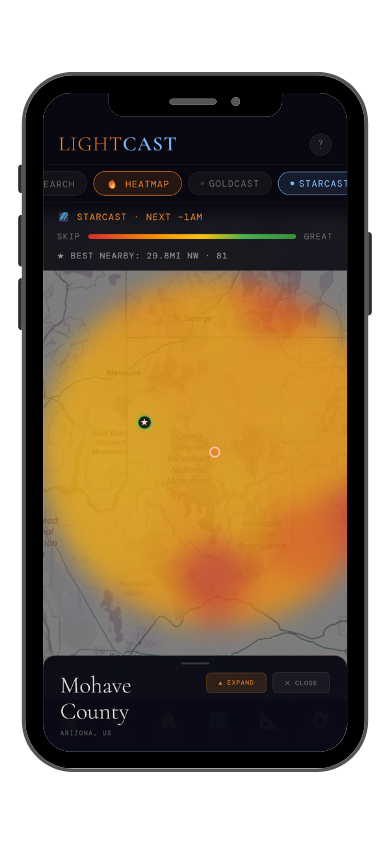
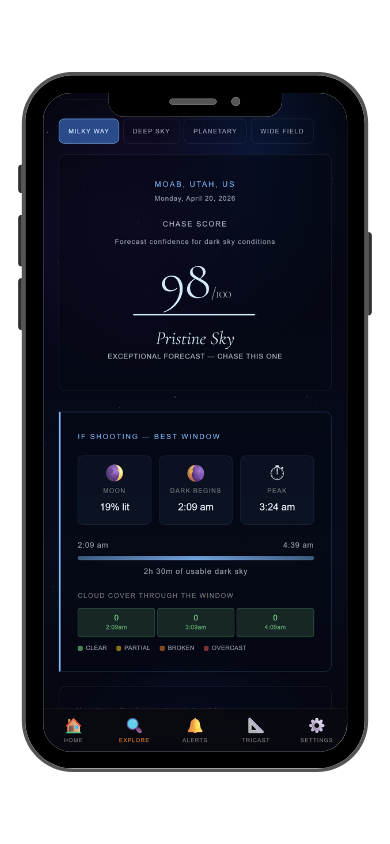
The live score above pulls today's forecast and runs it through StarCast's scoring model, factoring in cloud cover, moon illumination, Bortle class, humidity, and atmospheric transparency. Above 70 is an excellent night. Below 40, conditions are poor. The score updates daily.
What makes Palo Duro Canyon good for astrophotography?
Palo Duro Canyon State Park is the second largest canyon in the United States, dropping up to 800 feet through the Texas Panhandle south of Amarillo. Often called the "Grand Canyon of Texas," its layered red, orange, and white geological formations create dramatic foreground options for night photography. The Texas Panhandle's flat surrounding landscape and low population density between cities produce Bortle Class 3 to 4 conditions inside the canyon and darker sky to the south away from Amarillo's light dome. The canyon walls partially block distant city glow, and the canyon floor's river and cottonwood groves add texture to wide-angle compositions. This is one of the most visually distinctive dark sky foregrounds in the southern plains.
When is the Milky Way visible at Palo Duro Canyon?
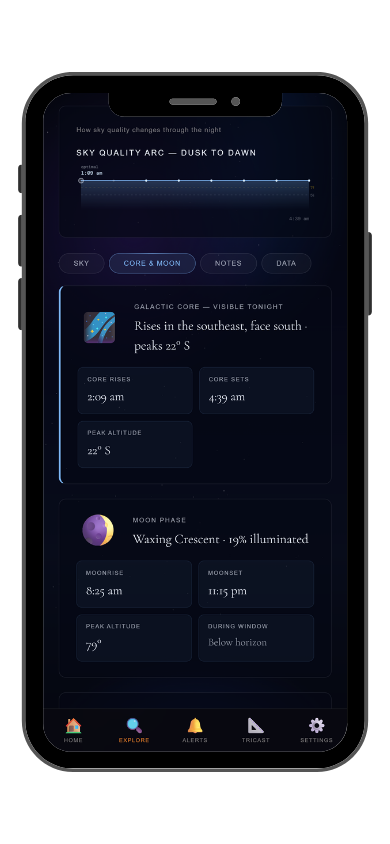
The galactic core is visible from March through October, with May through August the peak window. The Texas Panhandle has a semi-arid climate with generally clear skies and low humidity compared to eastern Texas. Summer thunderstorm activity can produce dramatic lightning in the distance while the core overhead remains clear. The park is open year-round with camping available, and the canyon's lower latitude gives good galactic center altitude during peak season.