Frequently asked
Is tonight good for stargazing at Perito Moreno?
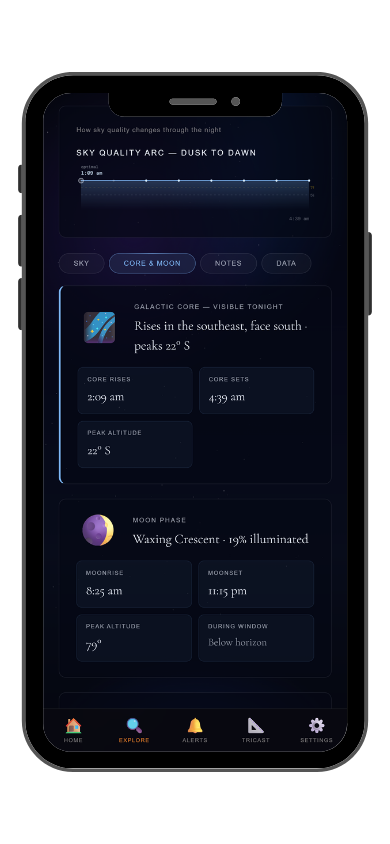
The live score above pulls today's forecast and runs it through StarCast's scoring model, factoring in cloud cover, moon illumination, Bortle class, humidity, and atmospheric transparency. Above 70 is an excellent night. Below 40, conditions are poor. The score updates daily.
What makes Perito Moreno good for astrophotography?
Perito Moreno Glacier in Argentine Patagonia is one of the most accessible and spectacular glaciers on Earth — a massive river of ice nearly 3 miles wide and 240 feet tall at its terminus, calving constantly into Lake Argentina. The surrounding Los Glaciares National Park landscape at nearly 50 degrees south latitude achieves Bortle Class 1 to 2 skies with the southern Milky Way, Magellanic Clouds, and stars of the southern sky blazing overhead on clear nights. The ice face of the glacier glows pale blue-white under starlight, and the icebergs floating in Lake Argentina create a floating foreground element unlike anything available at a northern hemisphere night photography location. The combination of glacial ice, mountain reflections, and southern hemisphere sky makes Perito Moreno one of the most extraordinary astrophotography environments on the planet.
When is the Milky Way visible at Perito Moreno?
The galactic core is visible year-round at this southern latitude. The main visitor season runs November through March, when austral summer provides daytime access but very short nights. The shoulder seasons of October and April offer the best combination of park access, reasonable temperatures, and meaningful darkness. Winter brings long nights but cold temperatures and reduced infrastructure. As with all Patagonian locations, weather windows for clear skies can be brief and unpredictable, making it essential to be ready to shoot at short notice.