Frequently asked
Is tonight good for stargazing in Pinedale?
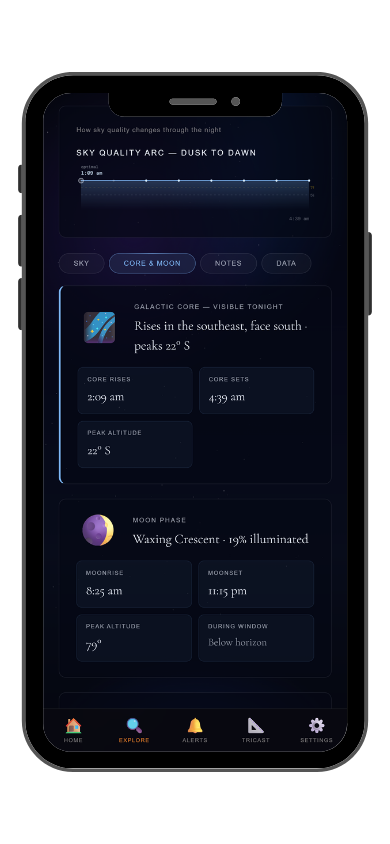
The live score above pulls today's forecast and runs it through StarCast's scoring model, factoring in cloud cover, moon illumination, Bortle class, humidity, and atmospheric transparency. Above 70 is an excellent night for astrophotography. Below 40, conditions are poor. The score updates daily.
What makes Pinedale good for astrophotography?
Pinedale sits at 7,200 feet in the Upper Green River valley, at the western base of the Wind River Range. The town is small enough that Bortle Class 2 to 3 skies begin right at the edge of the community, and the Bridger Wilderness to the east — one of the most heavily visited wilderness areas in the Rockies, yet one of the least light-polluted — offers spectacular high-alpine lake foregrounds including Fremont Lake, Half Moon Lake, and the glacially carved cirques of the Titcomb Basin. Fremont Lake just north of Pinedale is the second-largest natural lake in Wyoming and reflects the Wind River peaks with exceptional clarity. The Upper Green River valley to the south is a broad, open sagebrush basin with no meaningful light sources for miles, giving photographers a fully dark horizon for arch compositions.
When is the Milky Way visible near Pinedale?
The galactic core is visible from late March through early October. Fremont Lake and the lower-elevation trailheads are accessible from spring through late autumn. High-alpine destinations like Titcomb Basin require snowmelt access from mid-July onward. Prime astrophotography season runs May through September, with Fremont Lake providing a dramatic early-season option before high-country access opens. Wyoming's stable, dry continental climate at this latitude produces excellent summer shooting nights, and the Green River Basin's minimal population means the valley sky is dark in all directions.