Frequently asked
Is tonight good for stargazing in Pinetop-Lakeside?
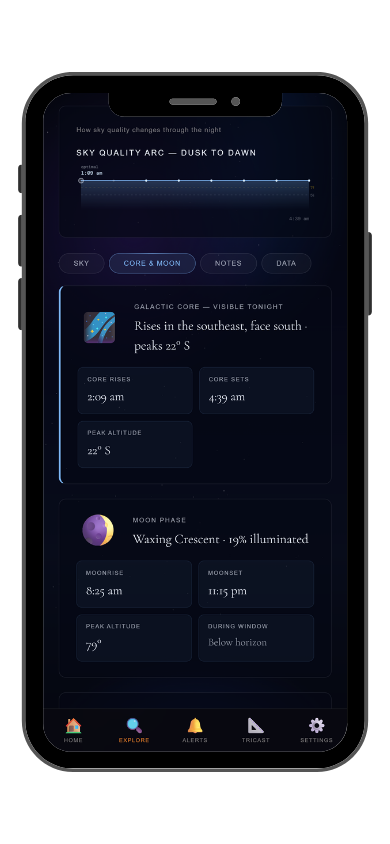
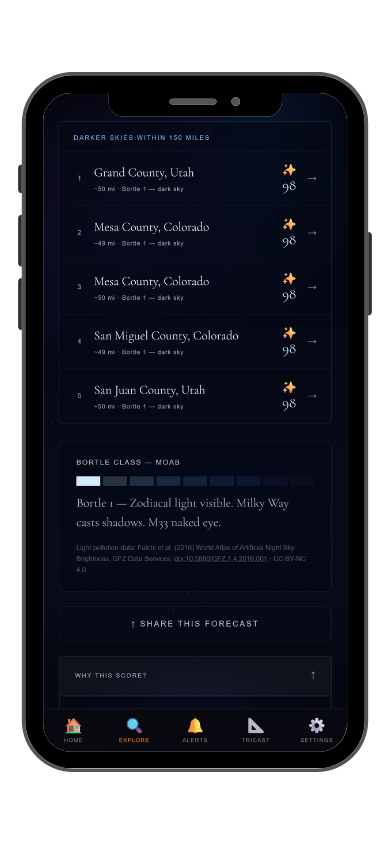
The live score above pulls today's forecast and runs it through StarCast's scoring model, factoring in cloud cover, moon illumination, Bortle class, humidity, and atmospheric transparency. Above 70 is an excellent night for astrophotography. Below 40, conditions are poor. The score updates daily.
What makes Pinetop-Lakeside good for astrophotography?
Pinetop-Lakeside sits at 6,900 feet in the White Mountains of eastern Arizona, tucked into the ponderosa pine forest of the Apache-Sitgreaves National Forest. The community is one of the highest-elevation towns in Arizona and one of the least light-polluted — Bortle Class 2 to 3 skies begin at the edge of the residential areas. The nearby lakes — Woodland Lake, Rainbow Lake, and Show Low Lake — provide water reflection foregrounds beneath the Milky Way in a landscape that feels more like the northern Rockies than the Southwest. The White Mountain Apache Reservation borders the community to the south, and its low development keeps the southern horizon toward the galactic core very dark. Arizona's stable monsoon-season pattern at this elevation often delivers clear nights after evening storms.
When is the Milky Way visible in Pinetop-Lakeside?
The galactic core is visible from late February through late October. At 6,900 feet, Pinetop-Lakeside offers some of the best low-effort access to genuinely dark skies in Arizona — no lengthy desert drives required. The prime astrophotography window runs May through September. The lakes are especially compelling foregrounds during June and July when the core arcs high over the southern horizon. Monsoon convection in July and August is a factor, but evenings often clear by late night, and the post-storm atmosphere is frequently exceptional.