Frequently asked
Is tonight good for stargazing in Prescott Valley?
The live score above pulls today's forecast and runs it through StarCast's scoring model, factoring in cloud cover, moon illumination, Bortle class, humidity, and atmospheric transparency. Above 70 is an excellent night for astrophotography. Below 40, conditions are poor. The score updates daily.
What makes Prescott Valley good for astrophotography?
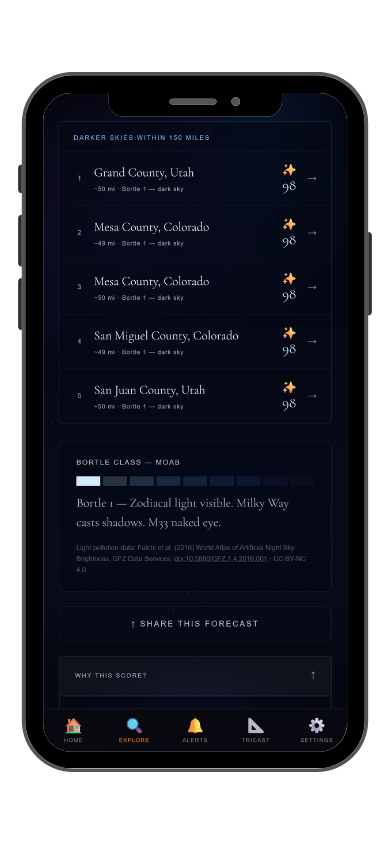
Prescott Valley sits at roughly 5,100 feet on the high Mingus Mountain plateau in central Arizona, immediately east of Prescott. The town itself is transitioning toward suburban density, but the Prescott National Forest and Black Hills Backcountry Byway provide rapid access to genuine darkness within 10 to 20 minutes. The eastern and southeastern skies — the direction of the Milky Way core — face open rangeland and forest with very little light interference. Mingus Mountain, rising to 7,815 feet to the east, is a well-known local astrophotography destination with Bortle Class 3 skies and sweeping views across the Verde Valley. The high-desert air at this elevation is dry year-round, supporting sharp, high-contrast images even from locations near town.
When is the Milky Way visible in Prescott Valley?
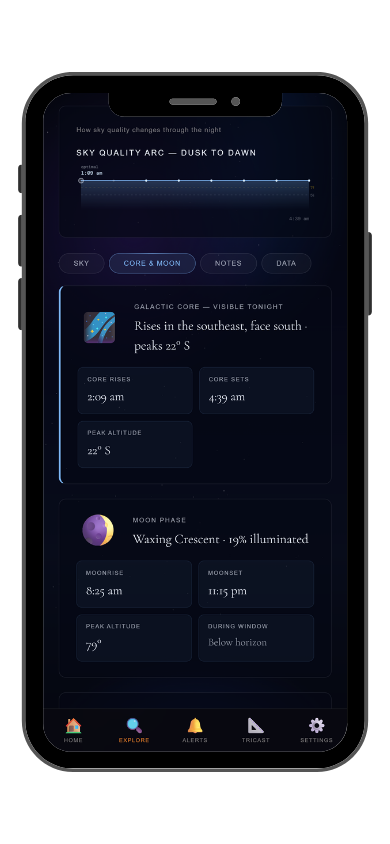
The galactic core is visible from late February through late October. The core rises in the southeast, making Mingus Mountain and the open terrain east of town particularly well-placed for galactic core compositions. Prime season runs May through September. Monsoon moisture arrives in July and August but rarely dominates the entire night; post-storm clearing frequently produces exceptional transparency. Arizona's lack of daylight saving time means astronomical darkness arrives on a consistent, predictable schedule throughout the year.