Frequently asked
Is tonight good for stargazing in Prescott?
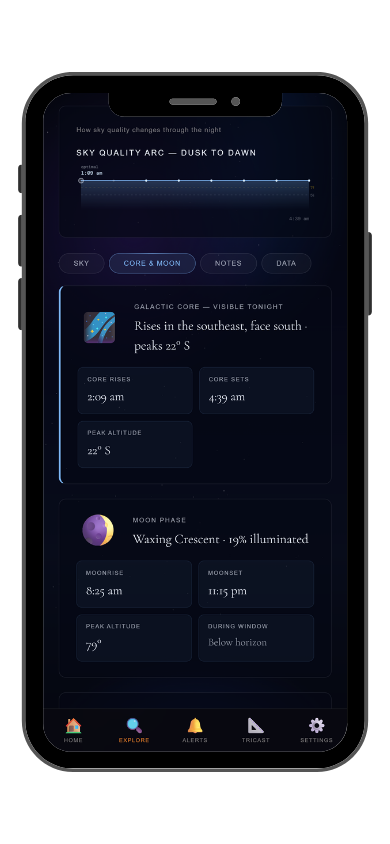
The live score above pulls today's forecast and runs it through StarCast's scoring model, factoring in cloud cover, moon illumination, Bortle class, humidity, and atmospheric transparency. Above 70 is an excellent night for astrophotography. Below 40, conditions are poor. The score updates daily.
What makes Prescott good for astrophotography?
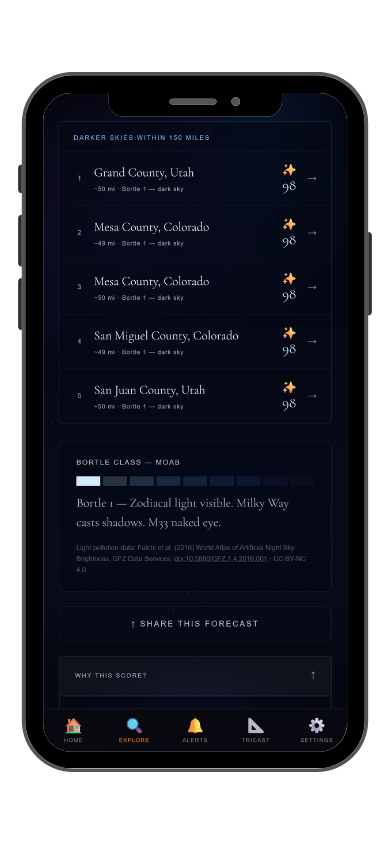
Prescott sits at 5,400 feet in the Bradshaw Mountains of central Arizona, with a high-desert climate that delivers more clear nights annually than almost anywhere else in the country. The city itself carries a faint light dome, but the Prescott National Forest surrounds it on three sides, providing Bortle Class 3 to 4 skies within a short drive. Granite Dells — a cluster of rounded granite boulders bisected by Watson Lake — is one of the most distinctive foreground settings in Arizona for Milky Way photography, combining water reflections with chaotic rock formations. The elevation keeps humidity low even during monsoon season, and Arizona's freedom from daylight saving time simplifies planning. The southern sky toward Sagittarius is wide open from most shooting locations in the national forest.
When is the Milky Way visible in Prescott?
The galactic core is visible from late February through late October at Prescott's latitude. The core rises early and climbs high from May through August, making those months the prime astrophotography season. Monsoon season (July through September) brings afternoon storms and increased humidity, but nights often clear after midnight with excellent post-storm transparency. The combination of elevation, southern sky exposure, and reliable winter clarity also makes Prescott productive for deep-sky and widefield astrophotography outside of galactic core season.