Frequently asked
Is tonight good for stargazing at Rannoch Moor?
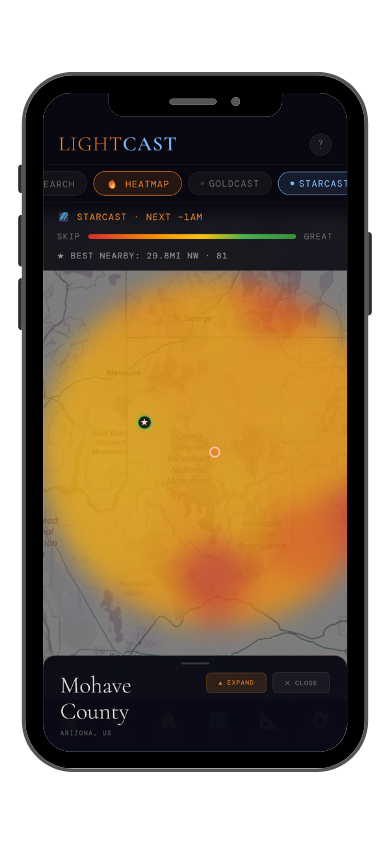
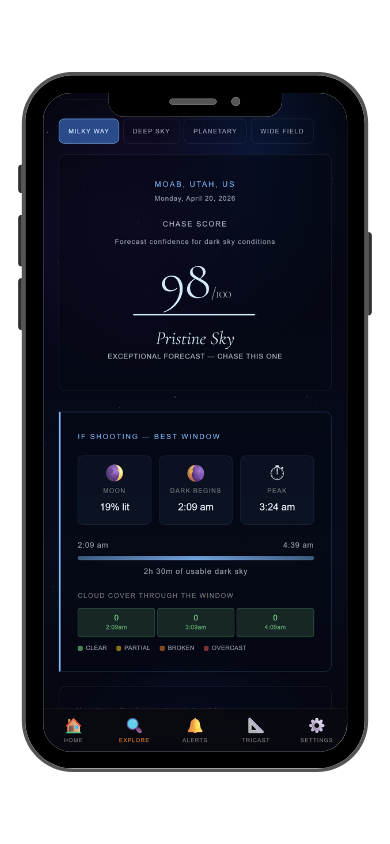
The live score above pulls today's forecast and runs it through StarCast's scoring model, factoring in cloud cover, moon illumination, Bortle class, humidity, and atmospheric transparency. Above 70 is an excellent night. Below 40, conditions are poor. The score updates daily.
What makes Rannoch Moor good for astrophotography?
Rannoch Moor is one of the largest and most remote wilderness plateaus in the British Isles, a 50 square mile expanse of blanket bog, lochan, and open moorland at 300 to 400 meters in the Scottish Highlands. It sits between Glencoe, Glen Lyon, and Loch Rannoch, ringed by mountains that screen almost all regional light. Glasgow and Edinburgh are 100 kilometers away in opposite directions and produce minimal impact. The A82 road skirts the moor's western edge, giving vehicle access to dark positions without a long walk, and the Rannoch Station railway halt puts the moor's eastern shore within reach by train. Bortle Class 2 to 3 conditions are typical.
When is the Milky Way visible at Rannoch Moor?
The galactic core is visible from March through October. Scotland's weather is the main variable: clear nights can be rare, but the moor's elevated, open position means cloud clears faster here than in sheltered glens. Late spring (April through May) and early autumn (September through October) tend to produce the most clear spells as blocking anticyclones sit over Scandinavia and bring easterly dry air. The moor's wide, flat horizon in every direction means the core is visible the moment it clears the low hills to the south.